CUETMOCK
  • Pricing
  • Mentors
Log inStart freeStart free mocks→

First test, then trust

Try a free CUET mock test.

Join 5,00,000+ students who rehearsed exam day on the exact NTA screen before sitting CUET. On the web and on Android.

Start free mocks →Get the Android app
CUETMOCK

India's #1 CUET Mock Test Platform. Original NCERT-based questions on the exact NTA exam screen — trusted by 5,00,000+ students since CUET 2022.

Get it onGoogle PlayScan to download the CUETMOCK app

Mock tests

  • CUET mock test series
  • Browse all papers
  • Commerce mocks
  • Humanities (Arts) mocks
  • Science mocks
  • Languages & GAT mocks
  • Free practice questions
  • Pricing

Resources

  • CUET exam guide
  • CUET syllabus
  • Universities accepting CUET
  • Expert blogs
  • News & notifications
  • Webinars & counselling
  • CUET score calculator
  • How we estimate your rank
  • FAQs

Company

  • About us
  • Our leadership & team
  • Our toppers
  • Mentors
  • For schools
  • Contact us
  • Terms
  • Privacy
  • Refund policy

Talk to us

+91 7696 6630 56info@cuetmock.comWhatsApp us

Our other platforms

  • JEE Mock — For IIT-JEE aspirants
  • NEET Mock — For NEET aspirants

Newsletter

Exam updates, study material and offers — no spam.

© 2026 NYC Ventures Pvt. Ltd.

701-702, Royal Business Park, Zirakpur, Punjab - 140603

  • Terms of use
  • Privacy policy
  • Refund policy
  • Contact us

iCUETMOCK is an independent preparation platform, not affiliated with the National Testing Agency (NTA). Always check exam details on the official NTA website.

  • Home
  • Mock tests
  • CUET guide
  • Pricing
  • Log in
Home/Practice questions/Economics
EconomicsMicro Economics: Market Equilibrium

Consider a market consisting of identical farms producing the same qu…

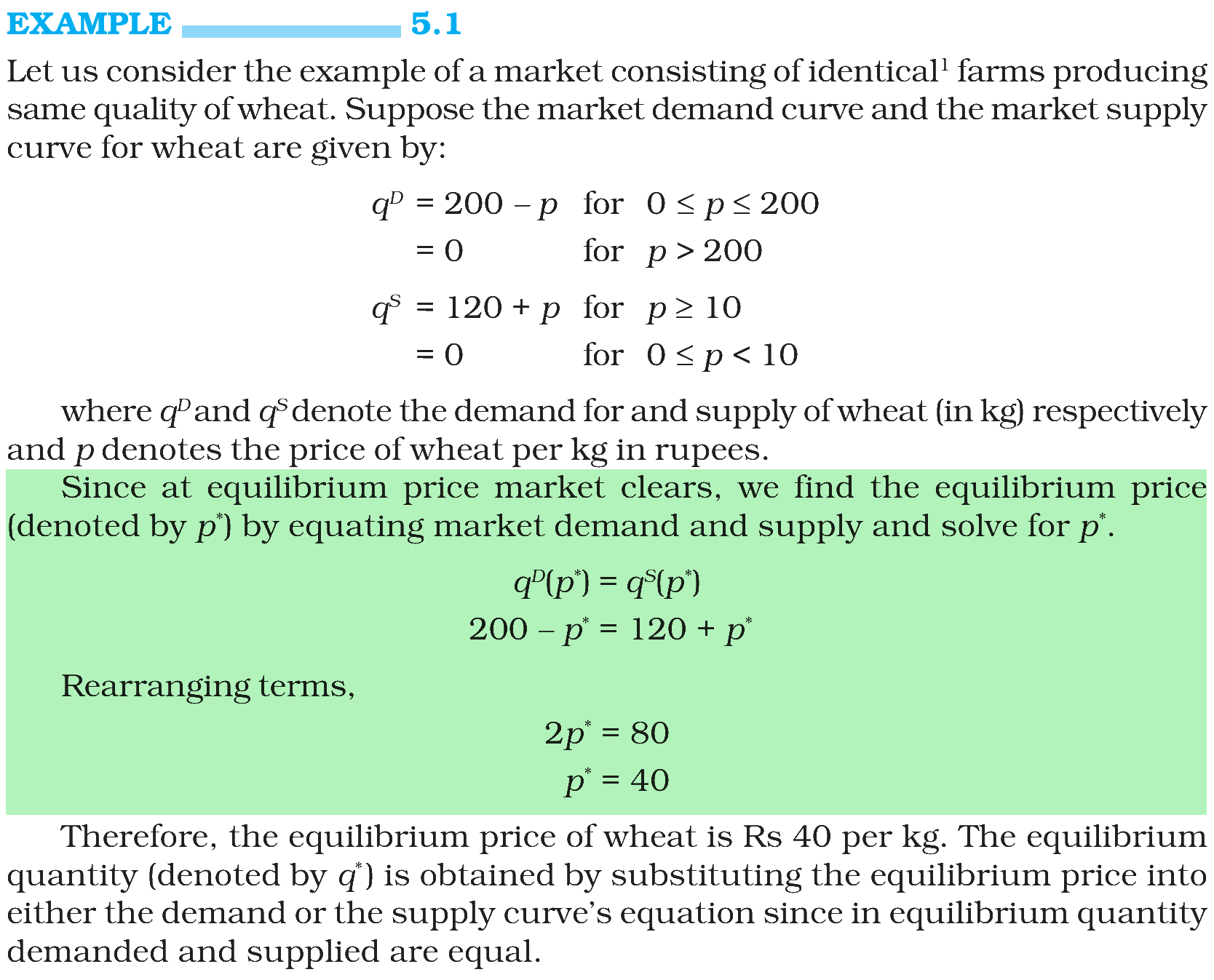
Consider a market consisting of identical farms producing the same quality of rice. The market demand curve and the market supply curve for rice are given by:
qD = 250 – p for 0 ≤ p ≤ 250
= 0 for p > 250
qS = 150 + p for p ≥ 10
= 0 for 0 ≤ p < 10
What will be the equilibrium price?
Answer & explanation+

Correct answer: option 2

The correct answer is Option (2) → 50

Given:

qD = 250 − p

qS = 150 + p

At the equilibrium price, market demand equals market supply.

    \( 250 - p = 150 + p \)

    \( 2p = 100 \)

    \( p^* = 50 \)

The equilibrium price is 50. At this price both demand and supply are 200.

NCERT (2026-27): NCERT extract

Advertisement

Practise more on Micro Economics: Market Equilibrium

Chapter-wise mocks on the real NTA exam screen, with solutions and your rank. Your first mocks are free.

Start free mocks →

Advertisement

Next questions

  1. Fill in the blank with the most appropriate word. ______ you deserve credit for the success of the show.English · Fill Blanks
  2. Rearrange the following phrases into a meaningful sentence. The beginning of the sentence has been given below. Read the options and find o…English · Arrange in Meaningful Sequence
  3. Kanan is working in Star Pro Ltd. He ensures that his department has necessary workforce and he co-operates with other departments for smoo…Business Studies · Nature and significance of Management
  4. Match List I with List II:List IList IIA. AsiaI. IslandB. GreenlandII. OceanC. PacificIII. CountryD. RussiaIV. ContinentChoose the correct…General Aptitude Test · General Knowledge
  5. The third ionisation enthalpies of copper, nickel and zinc are high. What do these high values indicate?Chemistry · Inorganic: D and F Block Elements
  6. Which of the following represents the borrowing requirements of the government for the purposes other than interest payments?Economics · Macro Economics: Government Budget and Economy
  7. Assertion(A)- Production is the most important activity of an enterprise. Reason(R)- Production plan is to be mandatorily prepared by all b…Entrepreneurship · Entrepreneurial Planning
  8. Examine the continuity of the function f(x) = […] at x = 1.Maths. Section B1 · Continuity and Differentiability
  9. Energy and momentum of a photon is given by the expressions, energy E = hnu , and momentum p = displaystyleh/(λ) , respectively, where nu i…Physics · Dual Nature of Radiation and Matter
  10. Each ether in List-I is heated with concentrated HI. Match List-I (ether and condition) with List-II (feature of its cleavage).List-IList-I…Chemistry · Organic: Alcohols, Phenols and Ethers