
Read the following paragraph and answer the given questions:
In order to link the alien DNA, the vector needs to have very few, preferably single, recognition sites for the commonly used restriction enzymes. Presence of more than one recognition site in the vector will generate several fragments, which will complicate the gene cloning. In order to link the alien DNA, the vector needs to have very few, preferably single, recognition sites for the commonly used restriction enzymes. Presence of more than one recognition sites within the vector will generate several fragments, which will complicate the gene cloning. The ligation of alien DNA is carried out at a restriction site present in one of the two antibiotic resistance genes. The recombinant plasmids will lose tetracycline resistance due to insertion of foreign DNA but can still be selected out from non-recombinant ones by plating the transformants on tetracycline containing medium. The recombinants will grow in ampicillin containing medium but not on that containing tetracycline. But, non- recombinants will grow on the medium containing both the antibiotics. In this case, one antibiotic resistance gene helps in selecting the transformants, whereas the other antibiotic resistance gene gets inactivated due to insertion of alien DNA, and helps in selection of recombinants. Origin of replication (ori) is a sequence from where replication starts and any piece of DNA when linked to this sequence can be made to replicate within the host cells. This sequence is also responsible for controlling the copy number of the linked DNA. So, if one wants to recover many copies of the target DNA it should be cloned in a vector whose origin support has high copy number.
In cloning vector pBR322, the BamH1 site codes for:
Answer & explanation
Correct answer: option 3
The correct answer is Option (3) → Tetracycline
The construction of the first recombinant DNA emerged from the possibility of linking a gene encoding antibiotic resistance with a native plasmid (autonomously replicating circular extra-chromosomal DNA) of Salmonella typhimurium. Stanley Cohen and Herbert Boyer accomplished this in 1972 by isolating the antibiotic resistance gene by cutting out a piece of DNA from a plasmid which was responsible for conferring antibiotic resistance.
"pBR322" is an example of a plasmid vector. It is a well-known plasmid that has been extensively used in genetic engineering experiments.
By using plasmid vectors like pBR322, researchers can insert a piece of foreign DNA (a gene of interest) into the plasmid, creating a recombinant DNA molecule. When the recombinant plasmid is introduced into bacterial cells, it replicates along with the host cell's DNA, producing multiple copies of the inserted DNA. This allows scientists to produce a large quantity of the gene they are interested in studying or manipulating.
In many cloning vectors (like the common pBR322 plasmid), there are antibiotic resistance genes for both ampicillin and tetracycline. The ampicillin resistance gene (Ampr) allows the colony to grow in media containing ampicillin, while the tetracycline resistance gene (Tetr) allows growth in media containing tetracycline.
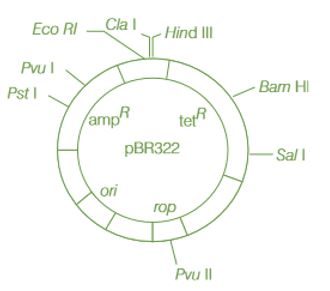
E. coli cloning vector pBR322 showing restriction sites (Hind III, EcoR I, BamH I, Sal I, Pvu II, Pst I, Cla I), ori and antibiotic resistance genes (ampR and tetR). rop codes for the proteins involved in the replication of the plasmid.