
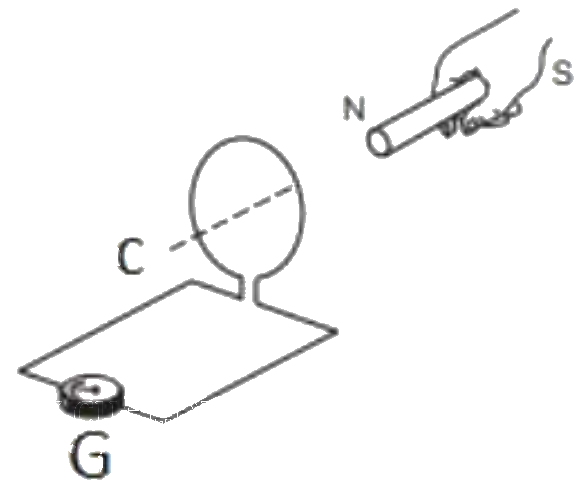
Figure shows a coil C connected to a galvanometer G. When the North-pole of a bar magnet is pushed towards the coil, the pointer in the galvanometer deflects. Regarding this set up, the following statements are given:
(A) It indicates the presence of electric current in the coil.
(B) The deflection is found to be smaller when the magnet is pushed towards the coil faster.
(C) There is repulsion in the moving magnet and the magnetic pole induced in the coil facing towards the N pole of the magnet.
(D) If the bar magnet does not move, there is no induced current in the coil.
Choose the correct answer from the options given below:
Answer & explanation
Correct answer: option 1
The correct answer is Option (1) → (A), (C) and (D) only
Moving the magnet changes the magnetic flux through the coil. By Faraday's law an emf is induced, and by Lenz's law the induced current opposes the change.
(A) It indicates the presence of electric current in the coil. — Correct. The pointer deflects only when a current flows through the galvanometer.
(B) The deflection is found to be smaller when the magnet is pushed towards the coil faster. — Incorrect. A faster push makes the flux change faster, so the induced emf, the current and the deflection are larger, not smaller.
(C) There is repulsion in the moving magnet and the magnetic pole induced in the coil facing towards the N pole of the magnet. — Correct. The induced current opposes the approach of the magnet, so the face of the coil towards the N pole becomes a north pole, which repels the magnet.
(D) If the bar magnet does not move, there is no induced current in the coil. — Correct. With no relative motion the flux does not change, so there is no induced emf.
NCERT (2026-27):
The Experiments of Faraday and Henry – “… When the North-pole of a bar magnet is pushed towards the coil, the pointer in the galvanometer deflects, indicating the presence of electric current in the coil. … The galvanometer does not show any deflection when the magnet is held stationary. … Further, the deflection (and hence current) is found to be larger when the magnet is pushed towards or pulled away from the coil faster.”
Lenz’s Law and Conservation of Energy – “… Note that magnetic moment associated with this current has North polarity towards the North-pole of the approaching magnet. … In this situation, the bar magnet experiences a repulsive force due to the induced current.”