Read the passage carefully and answer the questions:
Optically active polyhydroxy aldehydes or ketones or molecules which provide such units on hydrolysis are called carbohydrates. They can be broadly classified as monosaccharides, disaccharides and polysaccharides depending on their behavior towards hydrolysis. They are also classified as reducing or non reducing sugars. Another class of biomolecules is proteins which are polymers of twenty different amino acids linked by peptide bonds. Amino acids can be classified as acidic, basic or neutral depending on the relative number of amino and carboxyl groups in their molecule. The essential amino acids cannot be synthesized by our body and hence must be provided through diet. Nucleic acids are the polymers of nucleotides which in turn consist of a base, pentose sugar and phosphate. There are two types of nucleic acids namely, DNA and RNA which differ in the composition of sugar and a base.
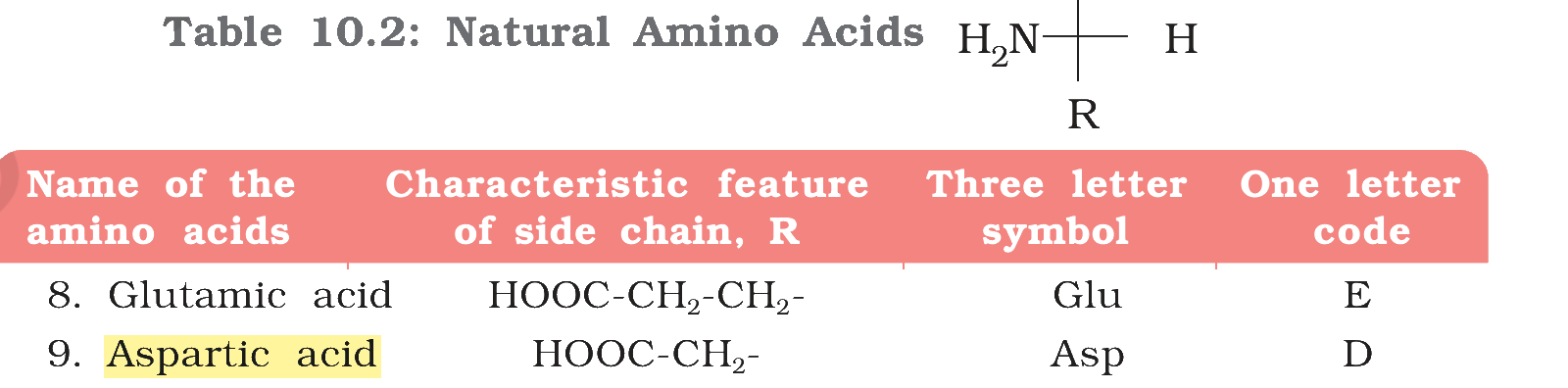
The side chain (R group) present in the "Aspartic Acid" amino acid is
Answer & explanation
Correct answer: option 2
The correct answer is Option (2) → \(HOOC-CH_2-\)
Every α-amino acid has the general formula \( \ce{H2N-CH(R)-COOH} \). The amino group, the carboxyl group and a hydrogen atom are common to all of them; they differ only in the side chain R, and R decides whether the amino acid is neutral, acidic or basic.
Aspartic acid is an acidic amino acid: it carries a second carboxyl group in its side chain. Its side chain is a \( \ce{-CH2COOH} \) group, so the full molecule is:
\( \displaystyle \ce{HOOC-CH2-CH(NH2)-COOH} \)
So the R group of aspartic acid is \( \ce{HOOC-CH2-} \), with two carboxyl groups against one amino group in the molecule. Glutamic acid, the other acidic amino acid, has one \( \ce{CH2} \) group more in its side chain.
NCERT (2026-27 edition):
Amino Acids – …