If \(K \equiv 5 \pmod{11}\), then all the possible non-negative values of K are :
Answer & explanation
Correct answer: option 3
The correct answer is Option (3) → {5, 16, 27, 38, 49, …}
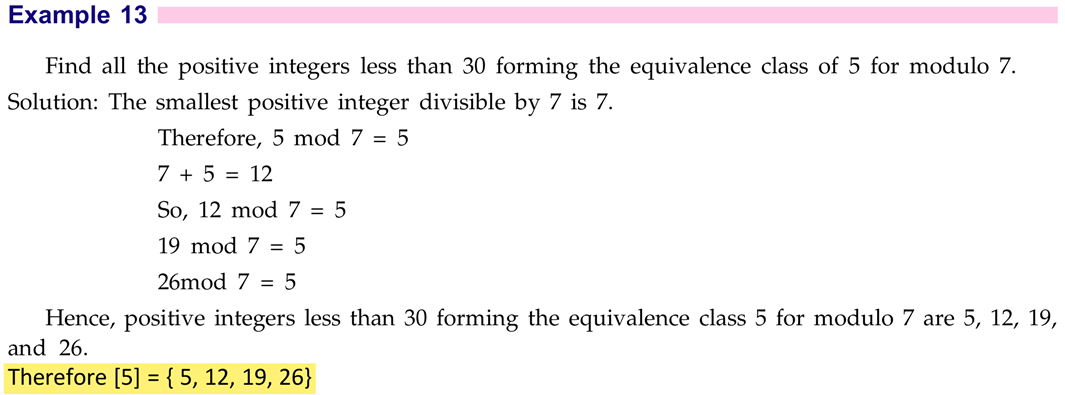
\(K \equiv 5 \pmod{11}\) means that 11 divides K − 5, that is, K leaves remainder 5 on division by 11:
\(K = 11m + 5\)
For non-negative K, m = 0, 1, 2, 3, 4, ...:
\(K = 5, 16, 27, 38, 49, \ldots\)
The value K = 5 itself (m = 0) is included, which is why the set must start at 5.
CBSE Applied Mathematics (Class XII):
Equivalence Class