Given that in an economy, consumption function is
C = 80 + 0.80Y and autonomous investment (I) = 120,
Match List-I with List-II
| List-I | List-II |
| (A) Equilibrium level of income | (I) 400 |
| (B) Break-even point | (II) 120 |
| (C) Investment multiplier | (III) 5 |
| (D) Value of savings at equilibrium | (IV) 1000 |
Choose the correct answer from the options given below:
Answer & explanation
Correct answer: option 3
The correct answer is Option (3) → (A)-(IV), (B)-(I), (C)-(III), (D)-(II)
In C = 80 + 0.80Y, autonomous consumption, the consumption at zero income, is 80 and the marginal propensity to consume (MPC) is 0.80. So the part of extra income saved is 1 − 0.80 = 0.20.
| List-I | List-II | Reason |
|---|---|---|
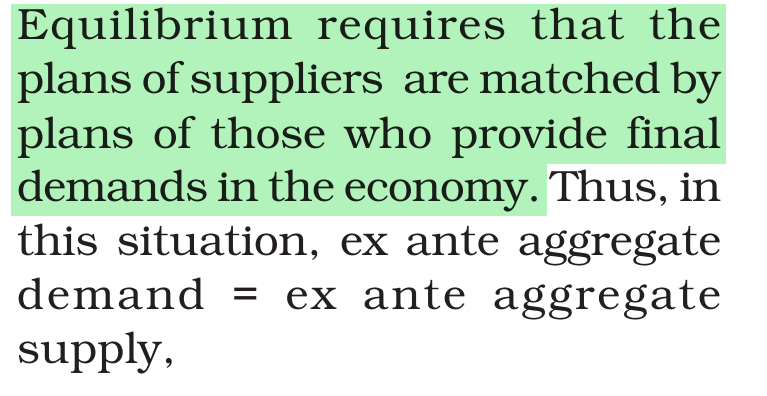
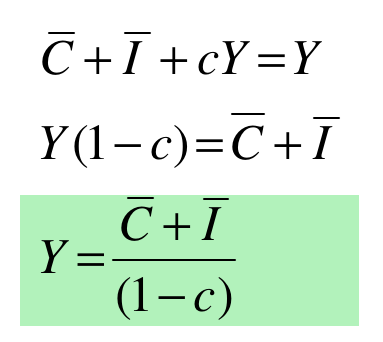
| (A) Equilibrium level of income | (IV) 1000 | At equilibrium, income equals consumption plus investment. Y = 80 + 0.80Y + 120 0.20Y = 200 Y = 1000 |
| (B) Break-even point | (I) 400 | At this income consumption equals income, so saving is zero. Y = 80 + 0.80Y 0.20Y = 80 Y = 400 |
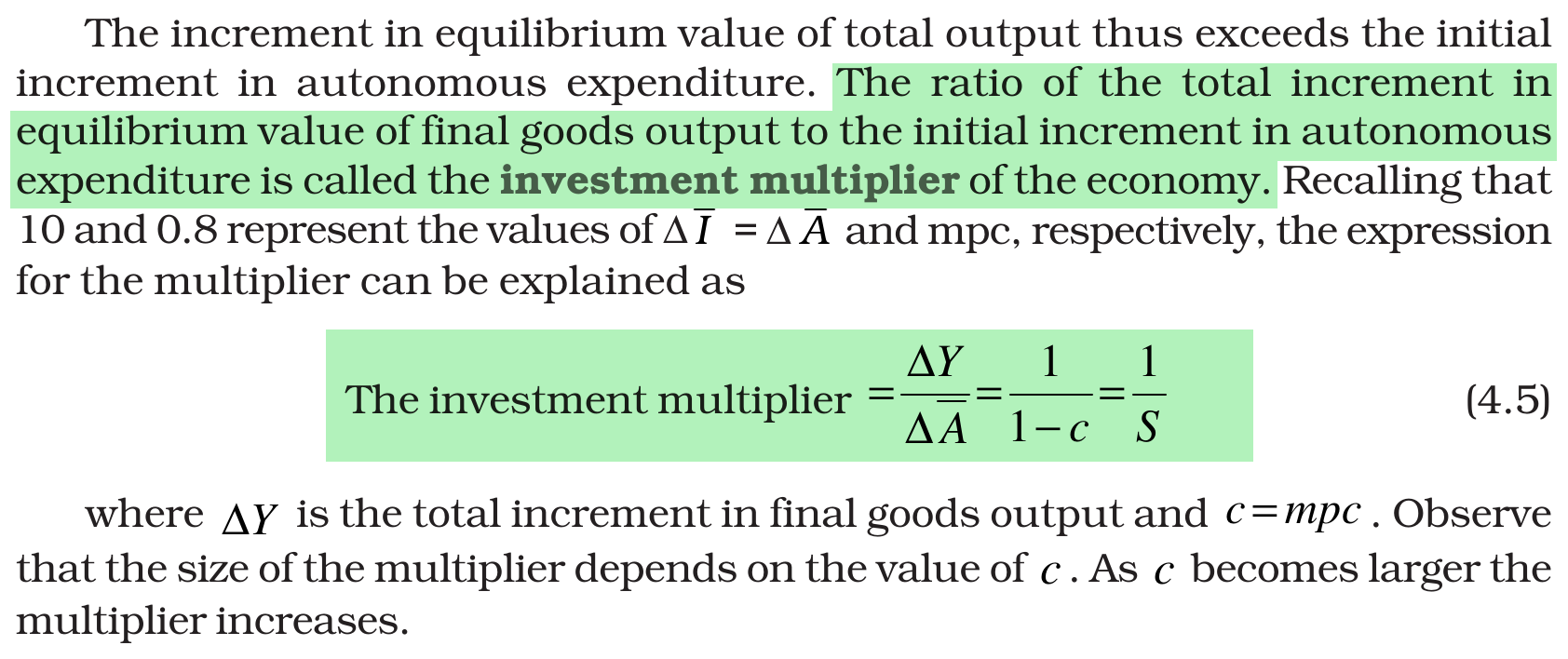
| (C) Investment multiplier | (III) 5 | The multiplier is 1 divided by (1 − MPC). 1 ÷ 0.20 = 5 |
| (D) Value of savings at equilibrium | (II) 120 | Saving is income minus consumption. At Y = 1000, C = 80 + 800 = 880. S = 1000 − 880 = 120 |
Note: None of the NCERT books (2026-27, 2025-26, 2023-24 or pre-rationalised) uses ‘break-even point’ for the consumption function. They use the term only for a firm, as the point where it earns only normal profit. For a consumption function, it is the income at which consumption equals income, so saving is zero.
NCERT (2026-27): Introductory Macroeconomics — Chapter 4: Determination of Income and Employment
NCERT (2026-27), chapter ‘The Theory of the Firm under Perfect Competition’: “4.4.4 The Normal Profit and Break-even Point The minimum level of profit that is needed to keep a firm in the existing business is defined as normal profit. A firm that does not make normal profits is not going to continue in business. … In the long run, a firm does not produce if it earns anything less than the normal profit. In the short run, however, it may produce even if the profit is less than this level. The point on the supply curve at which a firm earns only normal profit is called the break-even point of the firm.…” |