Identify the combination of technique and principle of management that is contradictory to each other.
A. Discipline and Method study
B. Unity of direction and Fatigue study
C. Initiative and Differential piece wage system
D.Stability of personnel and Motion study
E. Unity of command and Functional Foremanship
Choose the correct from the options given below.
Answer & explanation
Correct answer: option 1
The correct answer is Option (1) → E only
A. Discipline and Method study — Not contradictory (Incorrect). Discipline means obeying the rules of the organisation. Method study finds the best way to do a job. Workers can follow the best method and still obey the rules.
B. Unity of direction and Fatigue study — Not contradictory (Incorrect). Unity of direction means one head and one plan for activities with the same goal. Fatigue study fixes rest breaks for workers. The two deal with different matters.
C. Initiative and Differential piece wage system — Not contradictory (Incorrect). Initiative means encouraging workers to give ideas. The differential wage pays more to efficient workers. Both push workers to do better, so they support each other.
D. Stability of personnel and Motion study — Not contradictory (Incorrect). Stability of personnel means keeping staff in their jobs for long. Motion study removes useless movements from work. One does not stop the other.
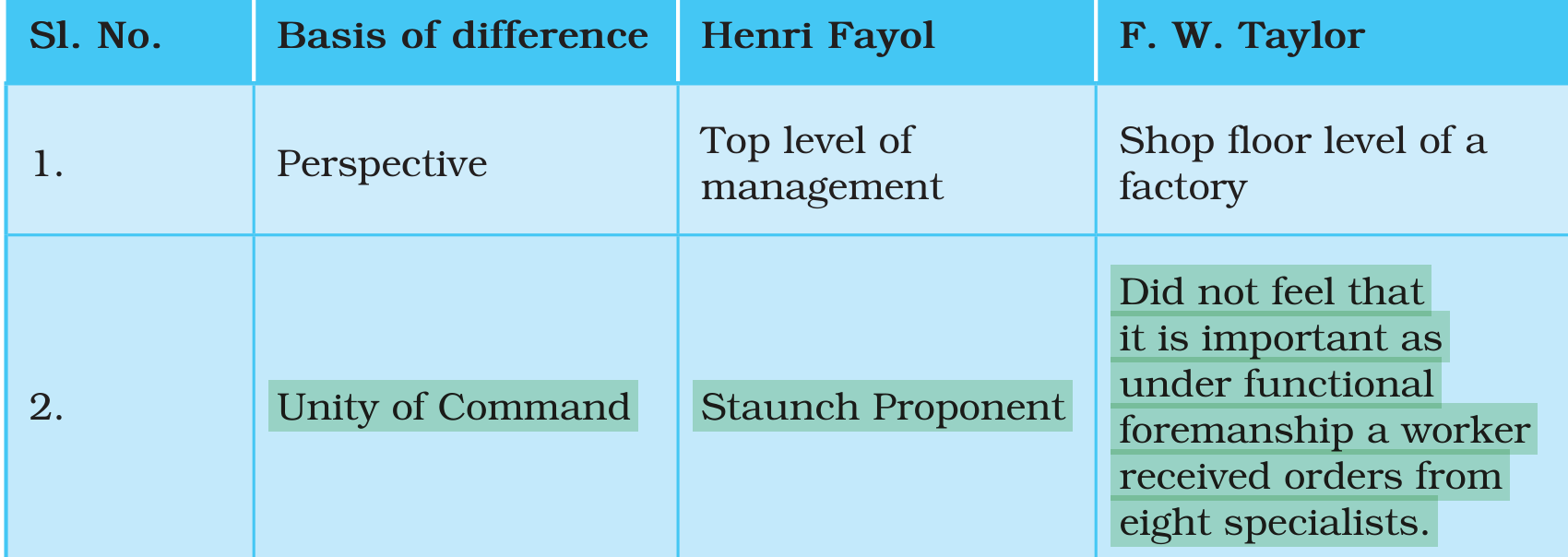
E. Unity of command and Functional Foremanship — Contradictory (Correct). Fayol’s unity of command says each worker should get orders from only one boss. Under Taylor’s functional foremanship, a worker gets orders from eight specialists. So using one means breaking the other.
NCERT (2026-27 Edition): “Functional Foremanship … Taylor advocated separation of planning and execution functions. This concept was extended to the lowest level of the shop floor. It was known as functional foremanship. …” “Unity of Command: According to Fayol there should be one and only one boss for every individual employee. If an employee gets orders from two superiors at the same time the principle of unity of command is violated. …”
|