
Find the values of x for which $f(x) = (x (x-2))^2$ is an increasing function. Also find the points on the curve, where the tangent is parallel to x-axis.
Answer & explanation
Correct answer: option 2
The correct answer is Option (2) → Increasing on $[0,1]∪[2,∞)$; Tangents parallel to x-axis at $x=0,1,2$.
Given $f(x) = (x (x-2))^2 = x^2 (x-2)^2, D_f= R$.
Differentiating w.r.t. x, we get
$f'(x) = x^2.2(x-2)+(x-2)^2.2x$
$= 2x (x-2) (x + x-2)=2x (x-2) (2x-2)$
$= 4x (x-1) (x-2)$.
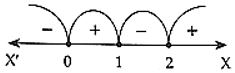
Now, the given function f is (strict) increasing iff $f'(x) > 0$
$⇒4x (x-1) (x-2) > 0$
$⇒x (x − 1) (x − 2) > 0$
$⇒x ∈ (0,1) ∪(2,0)$
⇒ f is (strict) increasing in $[0, 1] ∪ [2, ∞)$.
Further, the tangents will be parallel to x-axis iff $f'(x) = 0$
$⇒ 4x (x-1) (x-2)=0⇒x= 0, 1, 2$.
The given curve is $y = x^2 (x-2)^2$.
When $x = 0, y = 0$;
when $x = 1, y = 1^2 (1-2)^2 = 1 × (-1)^2=1 × 1 = 1;$
when $x = 2, y = 2^2 (2-2)^2=4×0 = 0$.
∴ The points on the given curve where the tangents are parallel to x-axis are (0, 0), (1, 1) and (2, 0).