
CUETMOCK
  • Pricing
  • Mentors
Log inStart freeStart free mocks→

First test, then trust

Try a free CUET mock test.

Join 5,00,000+ students who rehearsed exam day on the exact NTA screen before sitting CUET. On the web and on Android.

Start free mocks →Get the Android app
CUETMOCK

India's #1 CUET Mock Test Platform. Original NCERT-based questions on the exact NTA exam screen — trusted by 5,00,000+ students since CUET 2022.

Get it onGoogle PlayScan to download the CUETMOCK app

Mock tests

  • CUET mock test series
  • Browse all papers
  • Commerce mocks
  • Humanities (Arts) mocks
  • Science mocks
  • Languages & GAT mocks
  • Free practice questions
  • Pricing

Resources

  • CUET exam guide
  • CUET syllabus
  • Universities accepting CUET
  • Expert blogs
  • News & notifications
  • Webinars & counselling
  • CUET score calculator
  • How we estimate your rank
  • FAQs

Company

  • About us
  • Our leadership & team
  • Our toppers
  • Mentors
  • For schools
  • Contact us
  • Terms
  • Privacy
  • Refund policy

Talk to us

+91 7696 6630 56info@cuetmock.comWhatsApp us

Our other platforms

  • JEE Mock — For IIT-JEE aspirants
  • NEET Mock — For NEET aspirants

Newsletter

Exam updates, study material and offers — no spam.

© 2026 NYC Ventures Pvt. Ltd.

701-702, Royal Business Park, Zirakpur, Punjab - 140603

  • Terms of use
  • Privacy policy
  • Refund policy
  • Contact us

iCUETMOCK is an independent preparation platform, not affiliated with the National Testing Agency (NTA). Always check exam details on the official NTA website.

  • Home
  • Mock tests
  • CUET guide
  • Pricing
  • Log in
Home/Practice questions/Biology
BiologyOrganisms and Populations

Which one of the following is an example of co-evolution?

Which one of the following is an example of co-evolution?

Answer & explanation+

Correct answer: option 3

The correct answer is Option (3) → Wasp and Fig

Option (3) Wasp and Fig — Correct. Each fig species is pollinated only by its partner wasp, and the wasp lays eggs in the fig.

NCERT Extract:
Population Interactions – “… In many species of fig trees, there is a tight one-to-one relationship with the pollinator species of wasp (Figure 11.4). It means that a given fig species can be pollinated only by its ‘partner’ wasp species and no other species. The female wasp uses the fruit not only as an oviposition (egg-laying) site but uses the developing seeds within the fruit for nourishing its larvae. The wasp pollinates the fig inflorescence while searching for suitable egg-laying sites.”
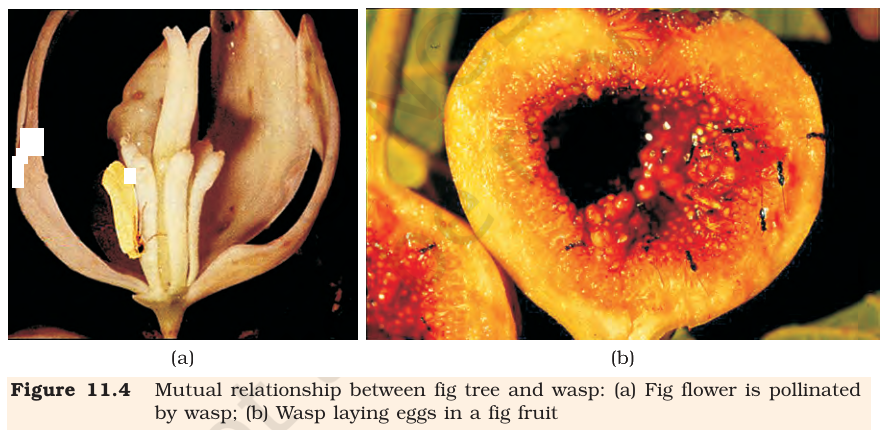
Textbook figure

Advertisement

Practise more on Organisms and Populations

Chapter-wise mocks on the real NTA exam screen, with solutions and your rank. Your first mocks are free.

Start free mocks →

Advertisement

Next questions

  1. What does the Latin phrase ‘memento mori’ mean?English · Foreign/Latin Words
  2. A Rajasthani miniature painting was made by several hands working together. Consider the following statements on how such a painting was ma…Fine Arts · The Rajasthani Schools of Painting
  3. The range of the principal value branch of cosec^-1 x isMaths. Section B1 · Inverse Trigonometric Functions
  4. A person has to cover 225 km distance. If he increases his speed by 5 km/h he reaches 1.5 hrs early. Find his initial speed (in km/hr).General Aptitude Test · Numerical Ability
  5. Which answer figure will complete the pattern in the question figure?General Aptitude Test · Verbal Reasoning
  6. Which of the following is not true of a voltaic cell?Chemistry · Physical: Electro Chemistry
  7. With which country India signed a 20 year Treaty of Peace and Friendship in 1971?Political Science · Politics in India Since Independence: India's External Relations
  8. Who among the following was not a Mauryan ruler?History · Ancient India: Kings, Farmers and Towns
  9. Which of the following is NOT an assumption of consumer equilibrium in "Cardinal utility analysis"?Economics · Micro Economics: Theory of Consumer behaviour
  10. Select the option that can be used as a one-word substitute for the given group of words. Easily provokedEnglish · One Word