Arrange the following oxides in the increasing order of their basic strength:
(A) \( V_2O_5 \)
(B) \( V_2O_3 \)
(C) \( V_2O_4 \)
(D) \( Mn_2O_7 \)
Choose the correct answer from the options given below:
Answer & explanation
Correct answer: option 1
The correct answer is Option (1) → (D), (A), (C), (B)
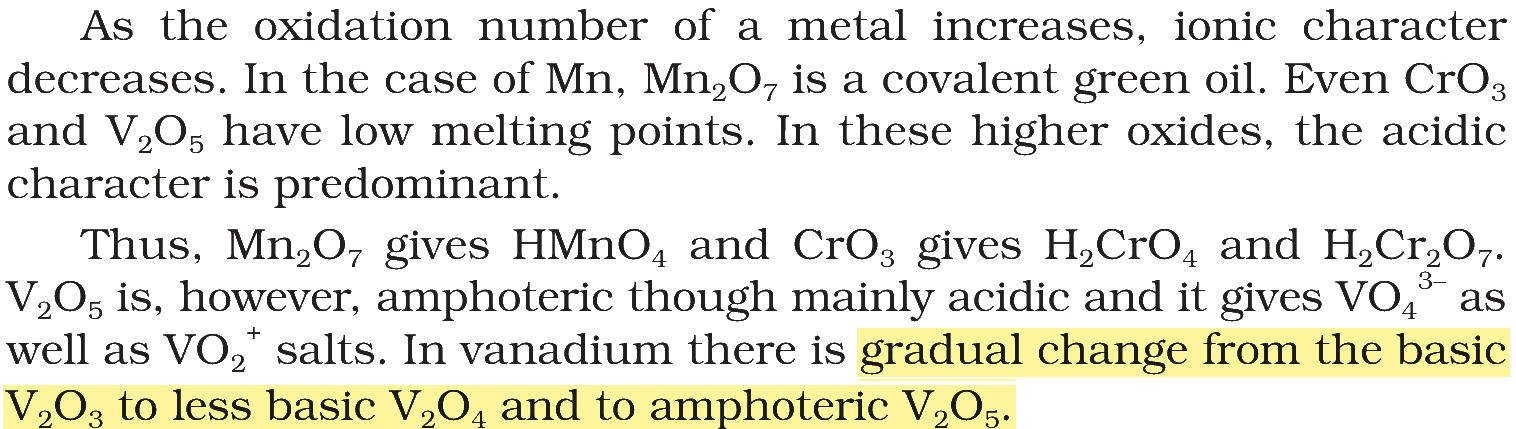
The acid–base character of a metal oxide depends on the oxidation state of the metal. In a low oxidation state the oxide is ionic and basic. As the oxidation state rises, the metal pulls the oxygen electrons towards itself, the bonding becomes covalent and the oxide becomes less basic, then amphoteric, then acidic.
The oxidation state of the metal in each oxide (2x + (−2)y = 0):
(A) \( \ce{V2O5} \): 2x = 10, so V is +5: amphoteric, though mainly acidic.
(B) \( \ce{V2O3} \): 2x = 6, so V is +3: basic.
(C) \( \ce{V2O4} \): 2x = 8, so V is +4: less basic than \( \ce{V2O3} \).
(D) \( \ce{Mn2O7} \): 2x = 14, so Mn is +7: strongly acidic.
Shortcut: The acidic \( \ce{Mn2O7} \) comes first and the basic \( \ce{V2O3} \) last, so the order starts with (D) and ends with (B): Options (1) and (2). Since \( \ce{V2O5} \) (+5) is less basic than \( \ce{V2O4} \) (+4), (A) comes before (C), which leaves Option (1).
NCERT (2026-27 edition):
Oxides and Oxoanions of Metals – …