Read the passage carefully and answer the questions based on the passage:
Calculate various parameters of Aggregate Demand, Aggregate Supply and related concepts
| Income (in ₹ Crore) | Consumption (in ₹ crore) |
| 0 | 50 |
| 50 | 75 |
| 100 | 100 |
| 200 | 150 |
| 300 | 200 |
| 400 | 250 |
When income is more than consumption, then value of Average Propensity to Save (APS) is.
Answer & explanation
Correct answer: option 1
The correct answer is Option (1) → More than zero.
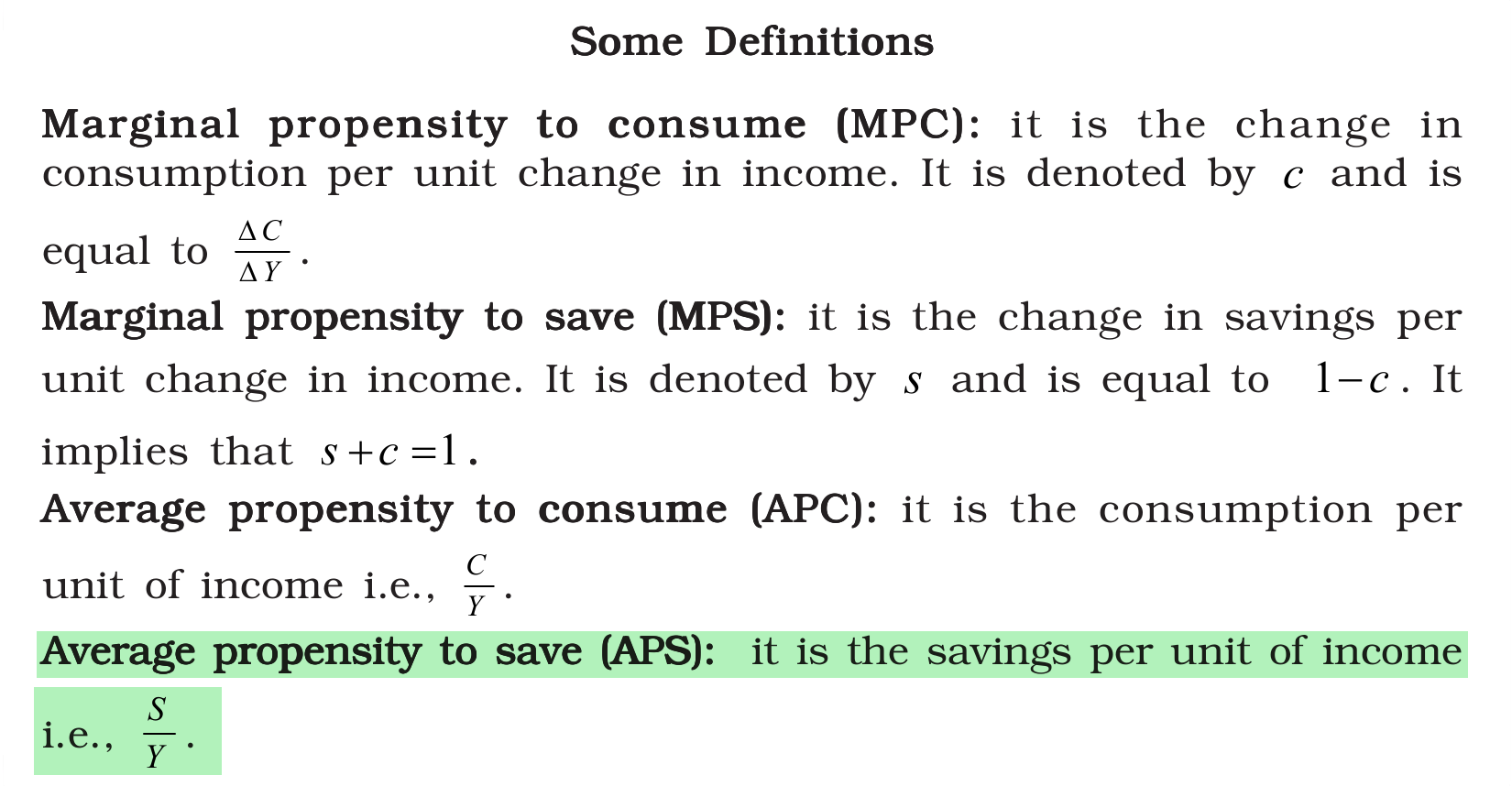
When income is more than consumption, a part of income is left over. This part is saving, and it is positive. The Average Propensity to Save (APS) is saving per unit of income, so it is more than zero.
In the table, at an income of ₹ 200 crore, consumption is ₹ 150 crore. Saving is ₹ 50 crore, so APS is 50 ÷ 200 = 0.25. APS stays below one here because saving is only a part of income.
NCERT (2026-27): Introductory Macroeconomics — Chapter 4: Determination of Income and Employment
|