
Haloarenes undergo the usual electrophilic reactions of the benzene ring such as halogenation, nitration, sulphonation and Friedel-Crafts reactions. Halogen atom besides being slightly deactivating is o, p-directing; therefore, further substitution occurs at ortho- and para-positions with respect to the halogen atom. The o, p-directing influence of halogen atom can be easily understood if we consider the resonating structures of halobenzene as shown:
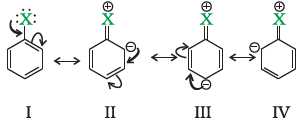 Due to resonance, the electron density increases more at ortho- and para-positions than at meta-positions. Further, the halogen atom because of its –I effect has some tendency to withdraw electrons from the benzene ring. As a result, the ring gets somewhat deactivated as compared to benzene and hence the electrophilic substitution reactions in haloarenes occur slowly and require more drastic conditions as compared to those in benzene
Which of the following is the necessary condition for desulphonation?
Answer & explanation
Correct answer: option 1
The correct answer is option 1. Remove volatile hydrocarbon by steam distillation.
Let us delve into why removing volatile hydrocarbons by steam distillation is a necessary condition for desulphonation and why the other options are not suitable.
Desulphonation is the reverse process of sulphonation, where a sulfonic acid group (\(-SO_3H\)) is removed from an aromatic compound. The general reaction for desulphonation can be represented as:
\(\text{Ar-SO}_3H \rightarrow \text{Ar-H} + \text{SO}_3\)
Necessary Condition for Desulphonation
Remove volatile hydrocarbon by steam distillation:
Reason: Steam distillation is a technique used to separate compounds based on their volatility in the presence of steam. During desulphonation, the goal is to break the bond between the aromatic ring and the sulfonic acid group. By applying steam distillation, the volatile hydrocarbon (the product of desulphonation) is continuously removed from the reaction mixture.
Effect: Removing the volatile hydrocarbon as it forms helps to drive the equilibrium of the reaction towards the formation of more hydrocarbon and \(\text{SO}_3\). This is a direct application of Le Chatelier's principle, which states that a system at equilibrium will adjust to counteract any change. By removing one of the products (the volatile hydrocarbon), the reaction is pushed further towards completion.
Why the Other Options Are Not Suitable
Low concentration of water:
Reason: Desulphonation typically requires an aqueous environment because water can help facilitate the removal of the \(-SO_3H\) group. A low concentration of water would not support the hydrolysis needed in the desulphonation process.
Effect: Insufficient water would slow down or inhibit the desulphonation process.
High concentration of sulphonating agent:
Reason: A high concentration of the sulphonating agent (\(\text{SO}_3\) or \(\text{H}_2\text{SO}_4\)) would favor the forward reaction (sulphonation) rather than the reverse reaction (desulphonation).
Effect: This would lead to more sulphonation rather than breaking the \(\text{Ar-SO}_3H\) bond to form \(\text{Ar-H}\).
A large excess of fuming sulphuric acid:
Reason: Fuming sulphuric acid is a strong sulphonating agent. Its presence in excess would drive the reaction towards sulphonation instead of desulphonation.
Effect: This condition would increase the formation of sulfonic acid groups on the aromatic compound rather than removing them.
Summary
The correct and necessary condition for desulphonation is the removal of volatile hydrocarbons by steam distillation. This method helps to drive the reaction towards the removal of the sulfonic acid group by continuously removing the product (the hydrocarbon), thus shifting the equilibrium towards desulphonation. The other conditions mentioned either favor the forward reaction (sulphonation) or do not provide the appropriate environment for desulphonation to occur efficiently.