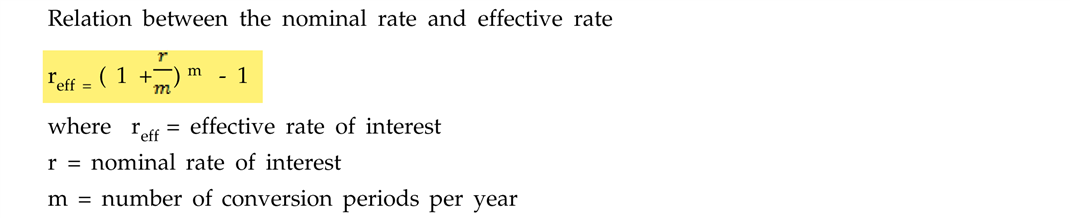
If \(r_{eff}\) = effective rate of interest, \(r\) = nominal rate of interest and \(m\) = number of conversion periods per year, the relationship between nominal rate and effective rate of interest is:
Answer & explanation
Correct answer: option 2
The correct answer is Option (2) → \(r_{eff}=\left(1+\displaystyle\frac{r}{m}\right)^m - 1\)
The effective rate is the rate which, compounded once a year, gives the same amount as the nominal rate r compounded m times a year. The rate per conversion period is \(\frac{r}{m}\), so Rs. 1 grows in one year to
\( \displaystyle \left(1 + \frac{r}{m}\right)^m \)
Equating this with \(1 + r_{eff}\):
\( \displaystyle r_{eff} = \left(1 + \frac{r}{m}\right)^m - 1 \)
CBSE Applied Mathematics (Class XII):
Nominal and Effective Rate of Interest