Carbonyl carbon in acetone is \( sp^2 \) hybridized. The C-O-C bond angle and the geometry of acetone is........
Answer & explanation
Correct answer: option 1
The correct answer is Option (1) → 120°; trigonal coplanar
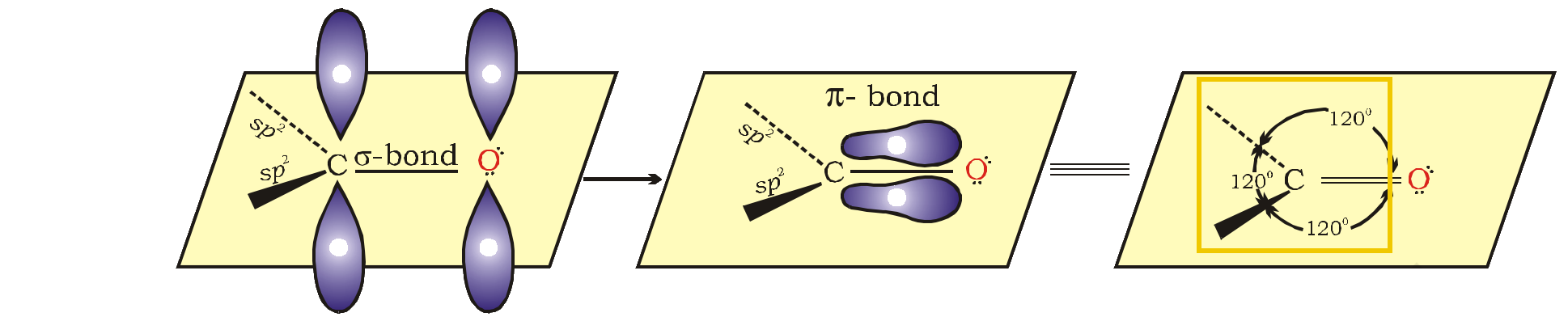
An sp2-hybridised carbon uses its three hybrid orbitals to form three σ bonds. These orbitals lie in one plane and point to the corners of a triangle, so the bond angles are about 120°. The fourth electron stays in the unhybridised p orbital and forms the π bond with oxygen.
In acetone, \( \ce{CH3-CO-CH3} \), the carbonyl carbon forms σ bonds to the two methyl carbons and to the oxygen atom.
Why the other options are incorrect
Option (2) 180°; linear — Incorrect. This is the geometry of an sp-hybridised carbon, as in ethyne or carbon dioxide.
Option (3) 109°28'; Tetrahedral — Incorrect. This is the geometry of an sp3 carbon, as in the methyl groups of acetone, not of the carbonyl carbon.
Option (4) 60°; trigonal planar — Incorrect. Three bonds in a plane spread out to 120°; an angle of 60° is not found around an sp2 carbon.
Note: It seems that there is a mistake in the original NTA paper, which prints “C-O-C bond angle” when it should read “C-C-O (or C-C-C) bond angle”; acetone has no C-O-C linkage.
NCERT (2026-27 edition):
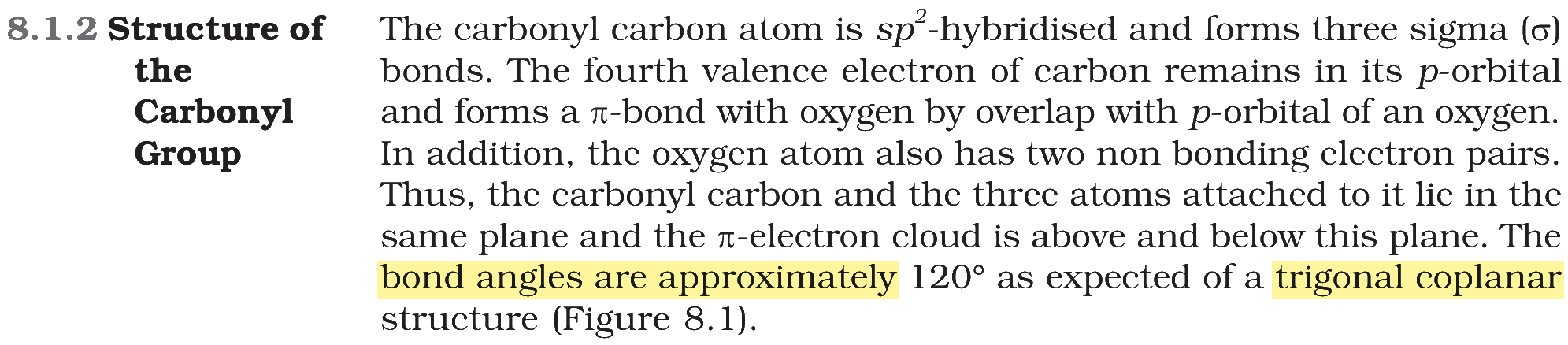
Structure of the Carbonyl Group