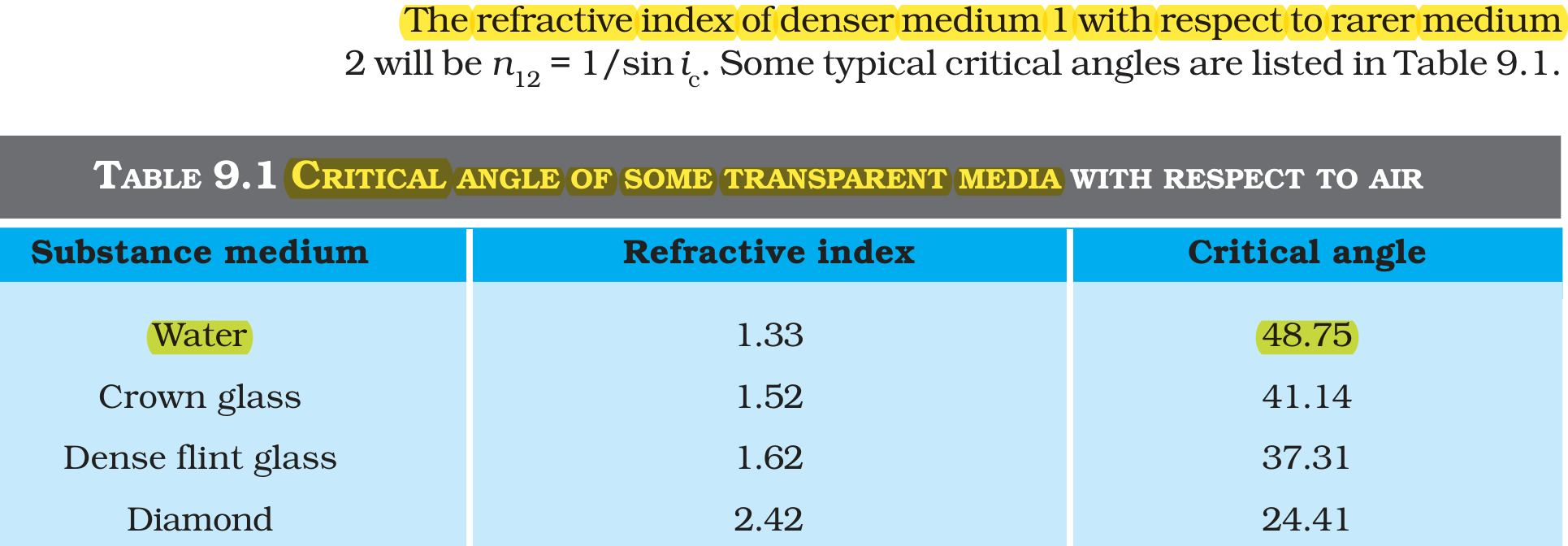
The critical angle is maximum when light travels from
Answer & explanation
Correct answer: option 4
The correct answer is Option (4) → water to air
A critical angle exists only when light goes from a denser to a rarer medium. For a medium of refractive index \( n \) with respect to air,
\( \displaystyle \sin C = \frac{1}{n} \)
So the smaller the refractive index of the denser medium, the larger the critical angle.
\( \text{water to air: } n = 1.33,\; \sin C = 0.75,\; C \approx 48.8^\circ \)
\( \text{glass to air: } n = 1.5,\; \sin C = 0.67,\; C \approx 41.8^\circ \)
Option (1) glass to air — Incorrect. Glass has the larger refractive index, so its critical angle (about \( 42^\circ \)) is smaller than that of water.
Option (2) air to water — Incorrect. Air to water is rarer to denser; total internal reflection cannot occur, so there is no critical angle.
Option (3) air to glass — Incorrect. Air to glass is also rarer to denser, so there is no critical angle.
Option (4) water to air — Correct. Water has a smaller refractive index than glass, so \( \sin C = 1/n \) is larger and the critical angle (about \( 49^\circ \)) is the maximum.
NCERT (2026-27):
Total Internal Reflection – …