
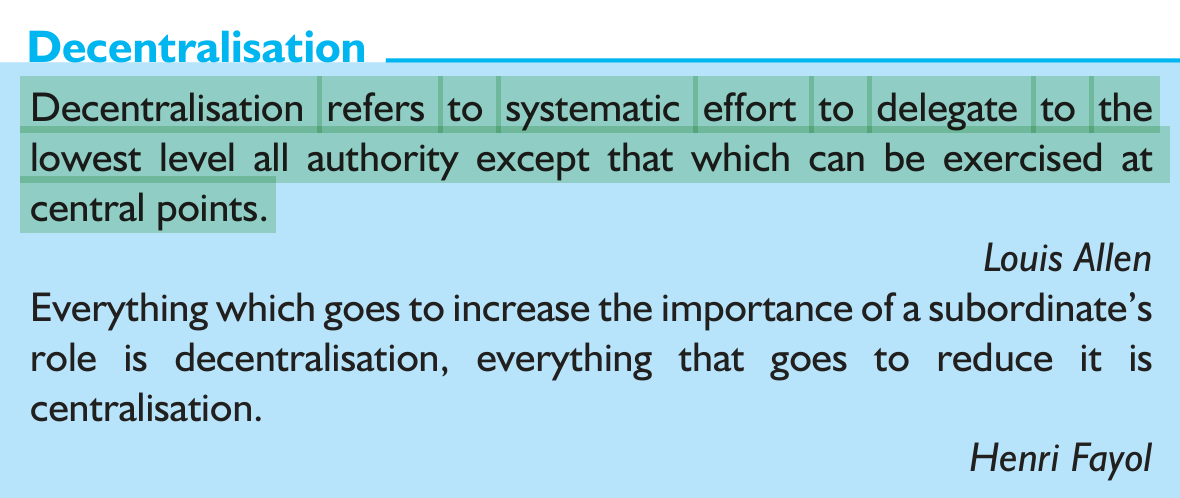
The systematic effort to delegate to the lowest level, all authority except that which can be exercised at central points is called:
Answer & explanation
Correct answer: option 1
The correct answer is Option (1) → Decentralisation
Option (1) Decentralisation — Correct. This is Louis Allen’s definition of decentralisation. Authority is passed down, in a planned way, to the lowest level where it can be used. Only the authority that must stay at the top (the central points) is kept there. So decisions are taken close to the point of action.
Option (2) Delegation — Incorrect. Delegation is the transfer of authority from a superior to his subordinate. It is between two persons. Decentralisation is delegation spread in a planned way through all the levels of the organisation.
Option (3) Centralisation — Incorrect. In centralisation, decision-making authority is kept with top management. This is the opposite of the definition.
Option (4) Departmentalisation — Incorrect. Departmentalisation means grouping similar activities into departments. It is a step of organising and is not about sharing authority.
NCERT (2026-27 Edition): “Decentralisation … Decentralisation explains the manner in which decision making responsibilities are divided among hierarchical levels. Put simply, decentralisation refers to delegation of authority throughout all the levels of the organisation. …” “Centralisation and Decentralisation Centralisation and decentralisation are relative terms, as seen from the existing status of various business enterprises. An organisation is centralised when decision-making authority is retained by higher management levels whereas it is decentralised when such authority is delegated.”
|
Note: The same/similar question has been asked in different years by NTA as per the details given below:
| 2026 | 2025 | 2024 | 2023 | 2022 |
| – | 31-05 S1 29-05 S2 | – | – | – |