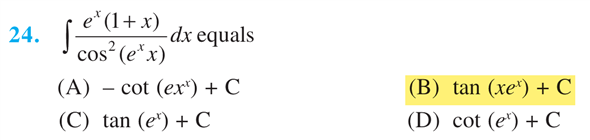
\(\int\displaystyle\frac{e^x(1+x)}{\cos^2\left(xe^x\right)}\,dx\) is equal to:
Answer & explanation
Correct answer: option 2
The correct answer is Option (2) → \(\tan\left(xe^x\right)+c\), where c is a constant
The numerator is the derivative of \(xe^x\), by the product rule:
\(\displaystyle \frac{d}{dx}\left(xe^x\right) = e^x+xe^x = e^x(1+x)\)
So put \(t = xe^x\), \(dt = e^x(1+x)\,dx\):
\(\displaystyle I = \int\frac{dt}{\cos^2t} = \int\sec^2t\,dt\)
\(= \tan t+c\)
\(= \tan\left(xe^x\right)+c\)
Why the other options are incorrect
Option (1) \(\cot\left(e^x\right)+c\), where c is a constant — Incorrect. The substitution is \(xe^x\), not \(e^x\), and \(\int\sec^2t\,dt\) is tan t, not cot t.
Option (3) \(\cot\left(xe^x\right)+c\), where c is a constant — Incorrect. The derivative of cot t is \(-\mathrm{cosec}^2t\), not \(\sec^2t\).
Option (4) \(\tan\left\{e^x(1+x)\right\}+c\), where c is a constant — Incorrect. The angle must be \(xe^x\), whose derivative appears in the numerator; \(e^x(1+x)\) is that derivative, not the angle.
NCERT (2026-27 edition):
Integration Using Trigonometric Identities