Arrange the following compounds in increasing order of their basicity
(A) Aniline
(B) p-Nitroaniline
(C) p-Toluidine
(D) p-Methoxyaniline
Choose the correct answer from the options given below:
Answer & explanation
Correct answer: option 3
The correct answer is Option (3) → (B), (A), (C), (D)
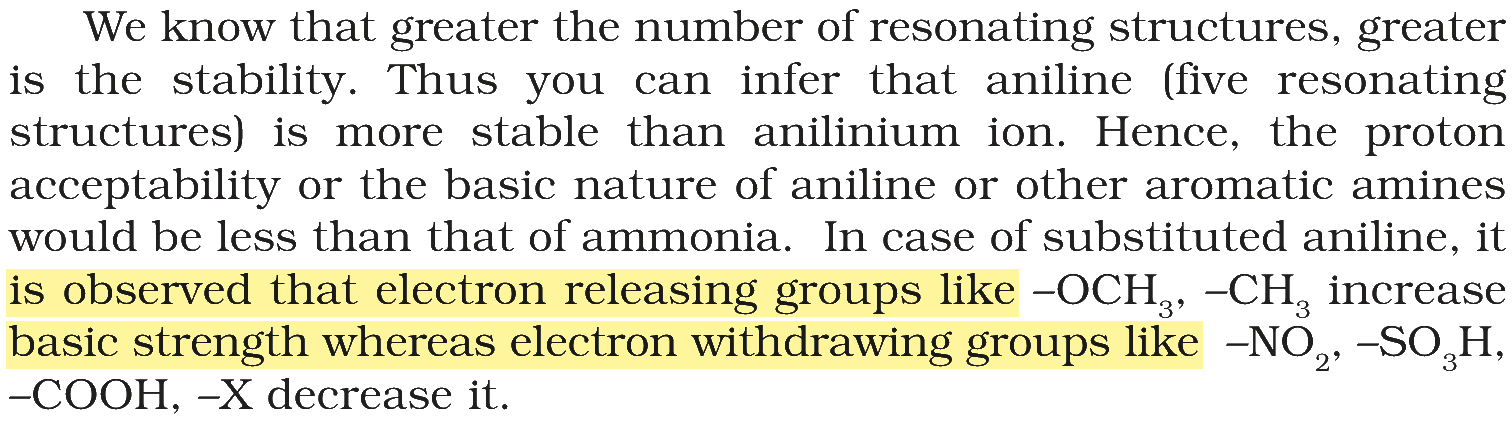
An amine is a base because the lone pair on nitrogen can accept a proton. In aniline this lone pair is partly delocalised into the benzene ring by resonance, so it is less available and aniline is a much weaker base than ammonia.
Taking the four compounds in turn:
(B) p-Nitroaniline: the –\( \ce{NO2} \) group at the para position withdraws electrons by both its −I and −R effects, and the nitrogen lone pair is delocalised right onto the nitro group. It is the weakest base (pKb about 13.0).
(A) Aniline: no substituent (pKb 9.38).
(C) p-Toluidine: the –\( \ce{CH3} \) group releases electrons by its +I effect and hyperconjugation, so it is a little stronger than aniline (pKb about 8.9).
(D) p-Methoxyaniline: the –\( \ce{OCH3} \) group at the para position releases electrons into the ring by its +R effect, which outweighs the −I effect of oxygen. It is the strongest base of the four (pKb about 8.7).
In increasing order of basicity:
\( \displaystyle \text{p-nitroaniline} \lt \text{aniline} \lt \text{p-toluidine} \lt \text{p-methoxyaniline} \)
Shortcut: p-Nitroaniline is the weakest and aniline comes next, so the order starts (B), (A): Options (1) and (3). Since –\( \ce{OCH3} \) releases electrons more strongly than –\( \ce{CH3} \), (D) comes last, which leaves Option (3).
NCERT (2026-27 edition):
Arylamines versus Ammonia – …