
CUETMOCK
  • Pricing
  • Mentors
Log inStart freeStart free mocks→

First test, then trust

Try a free CUET mock test.

Join 5,00,000+ students who rehearsed exam day on the exact NTA screen before sitting CUET. On the web and on Android.

Start free mocks →Get the Android app
CUETMOCK

India's #1 CUET Mock Test Platform. Original NCERT-based questions on the exact NTA exam screen — trusted by 5,00,000+ students since CUET 2022.

Get it onGoogle PlayScan to download the CUETMOCK app

Mock tests

  • CUET mock test series
  • Browse all papers
  • Commerce mocks
  • Humanities (Arts) mocks
  • Science mocks
  • Languages & GAT mocks
  • Free practice questions
  • Pricing

Resources

  • CUET exam guide
  • CUET syllabus
  • Universities accepting CUET
  • Expert blogs
  • News & notifications
  • Webinars & counselling
  • CUET score calculator
  • How we estimate your rank
  • FAQs

Company

  • About us
  • Our leadership & team
  • Our toppers
  • Mentors
  • For schools
  • Contact us
  • Terms
  • Privacy
  • Refund policy

Talk to us

+91 7696 6630 56info@cuetmock.comWhatsApp us

Our other platforms

  • JEE Mock — For IIT-JEE aspirants
  • NEET Mock — For NEET aspirants

Newsletter

Exam updates, study material and offers — no spam.

© 2026 NYC Ventures Pvt. Ltd.

701-702, Royal Business Park, Zirakpur, Punjab - 140603

  • Terms of use
  • Privacy policy
  • Refund policy
  • Contact us

iCUETMOCK is an independent preparation platform, not affiliated with the National Testing Agency (NTA). Always check exam details on the official NTA website.

  • Home
  • Mock tests
  • CUET guide
  • Pricing
  • Log in
Home/Practice questions/Physics
PhysicsElectric Charges and Fields

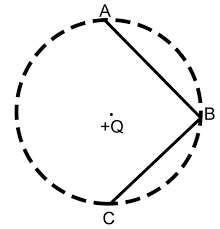
A positive charge (+q) is located at the centre of a circle as shown…

A positive charge (+q) is located at the centre of a circle as shown in figure. W1 is the work done in taking a unit positive charge from A to B and W2 is the work done in taking the same charge from A to C. Then.


Answer & explanation+

Correct answer: option 3

Point A, B and C are at the same distance from charge +q; hence electrical potential is the same at these points, i.e.  There is no potential difference between A, B and C. Hence W1 = W2 = 0. 

Advertisement

Practise more on Electric Charges and Fields

Chapter-wise mocks on the real NTA exam screen, with solutions and your rank. Your first mocks are free.

Start free mocks →

Advertisement

Next questions

  1. Choose the word from the options given below that is opposite in meaning to the given underlined word: FOEEnglish · Antonyms
  2. निम्नलिखित उदहारणों में से जानवरों से लगने वाला डर किस फोबिया के कारण होता है?Hindi · Phobia
  3. Match the following Mughal capitals in List I with the rulers under whom they became the capital in List II correctly: List- I (Capitals) L…History · Medieval India: Kings and Chronicles
  4. Assertion: The capital account of a partner does not show a debit balance in spite of regular and consistent losses year after year in the…Accountancy Part A · Accounting for Partnership
  5. Which of the following letter cluster will replace the question mark (?) to complete the given series? SXP, PVO, MTN, ? , GPLGeneral Aptitude Test · General Ability
  6. Where in a computer would you use a 'joystick' for computer games and assistive technology?General Aptitude Test · General Knowledge
  7. Assertion:. Rural Periodic markets are held on specified dates and move from one place to another. Reasoning: The shopkeepers of Rural Peri…Geography · Fundamentals of Human Geography: Tertiary and Quaternary Activities
  8. Read the passage carefully and answer the following questions: Fingerprints are the marks made by the ridges on the ends of the fingers and…English · Comprehension - (Narrative / Factual)
  9. The energy of the stars comes mainly from which of the following?General Aptitude Test · General Knowledge
  10. Anchal was studying for her economics examination. She wanted to know about the TR curve of a firm under perfect competition. She went to h…Economics · Micro Economics: Theory of Firms under Perfect Competition