Which of the following oxoacids of chlorine is most acidic?
Answer & explanation
Correct answer: option 4
The correct answer is Option (4) → \(HClO_4\)
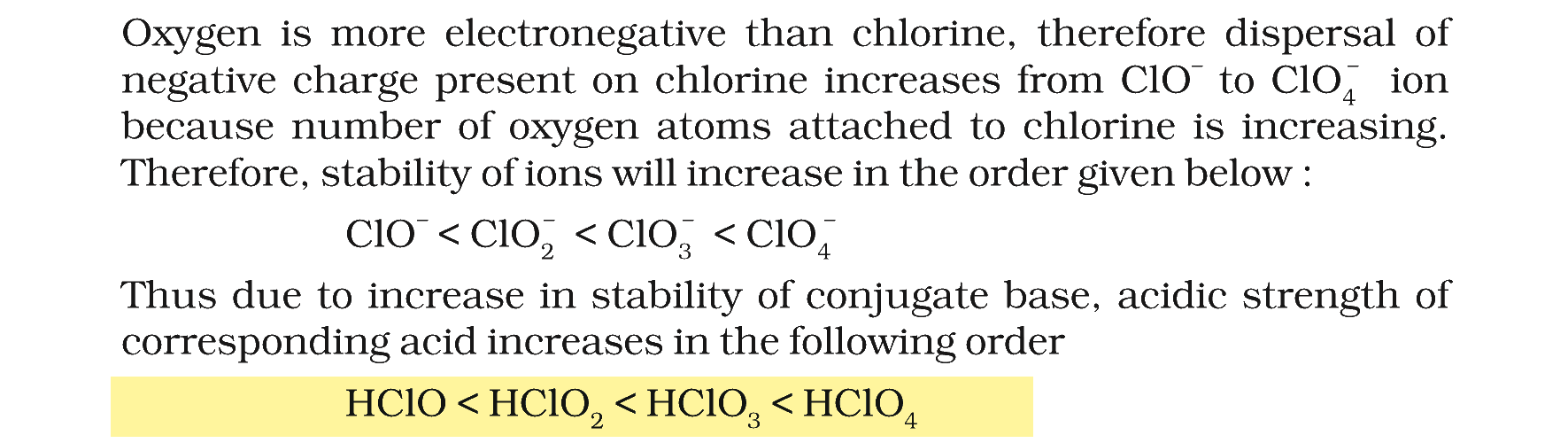
The strength of an oxoacid depends on how stable its conjugate base (anion) is. The more stable the anion, the more easily the acid gives up its proton. In the oxoacids of chlorine, every extra oxygen atom (more electronegative than chlorine) pulls electron density away and lets the negative charge of the anion spread over more oxygen atoms:
\( \ce{ClO-} < \ce{ClO2-} < \ce{ClO3-} < \ce{ClO4-} \) (stability of the anion)
The oxidation state of chlorine rises at the same time (+1, +3, +5, +7). So the acidic strength increases in the same order:
\( \ce{HClO} < \ce{HClO2} < \ce{HClO3} < \ce{HClO4} \)
In \( \ce{ClO4^{-}} \) the charge is shared by four equivalent oxygen atoms, so perchloric acid, HClO4, is the most acidic; it is one of the strongest acids known.
Why the other options are incorrect
Option (1) \(HClO\) — Incorrect. Hypochlorous acid (Cl +1); its anion has only one oxygen to hold the charge, so it is the weakest of the four.
Option (2) \(HClO_2\) — Incorrect. Chlorous acid (Cl +3); stronger than HClO but weaker than \( \ce{HClO3} \).
Option (3) \(HClO_3\) — Incorrect. Chloric acid (Cl +5); a strong acid, but its anion has one oxygen fewer than \( \ce{ClO4^{-}} \).
Note: This question is from the pre-rationalised NCERT book (2022-23). The topic is not there in the latest NCERT book (2026-27), and it is also out of the CUET 2026 syllabus.
NCERT Exemplar:
Oxoacids of Halogens – …