CUETMOCK
  • Pricing
  • Mentors
Log inStart freeStart free mocks→

First test, then trust

Try a free CUET mock test.

Join 5,00,000+ students who rehearsed exam day on the exact NTA screen before sitting CUET. On the web and on Android.

Start free mocks →Get the Android app
CUETMOCK

India's #1 CUET Mock Test Platform. Original NCERT-based questions on the exact NTA exam screen — trusted by 5,00,000+ students since CUET 2022.

Get it onGoogle PlayScan to download the CUETMOCK app

Mock tests

  • CUET mock test series
  • Browse all papers
  • Commerce mocks
  • Humanities (Arts) mocks
  • Science mocks
  • Languages & GAT mocks
  • Free practice questions
  • Pricing

Resources

  • CUET exam guide
  • CUET syllabus
  • Universities accepting CUET
  • Expert blogs
  • News & notifications
  • Webinars & counselling
  • CUET score calculator
  • How we estimate your rank
  • FAQs

Company

  • About us
  • Our leadership & team
  • Our toppers
  • Mentors
  • For schools
  • Contact us
  • Terms
  • Privacy
  • Refund policy

Talk to us

+91 7696 6630 56info@cuetmock.comWhatsApp us

Our other platforms

  • JEE Mock — For IIT-JEE aspirants
  • NEET Mock — For NEET aspirants

Newsletter

Exam updates, study material and offers — no spam.

© 2026 NYC Ventures Pvt. Ltd.

701-702, Royal Business Park, Zirakpur, Punjab - 140603

  • Terms of use
  • Privacy policy
  • Refund policy
  • Contact us

iCUETMOCK is an independent preparation platform, not affiliated with the National Testing Agency (NTA). Always check exam details on the official NTA website.

  • Home
  • Mock tests
  • CUET guide
  • Pricing
  • Log in
Home/Practice questions/Economics
EconomicsMacro Economics: Determination of Income and Employment

If the marginal propensity to consume is 0.8, the value of the invest…

If the marginal propensity to consume is 0.8, the value of the investment multiplier will be :

Answer & explanation+

Correct answer: option 2

The correct answer is Option (2) → 5

Given:

Marginal propensity to consume, MPC = 0.8

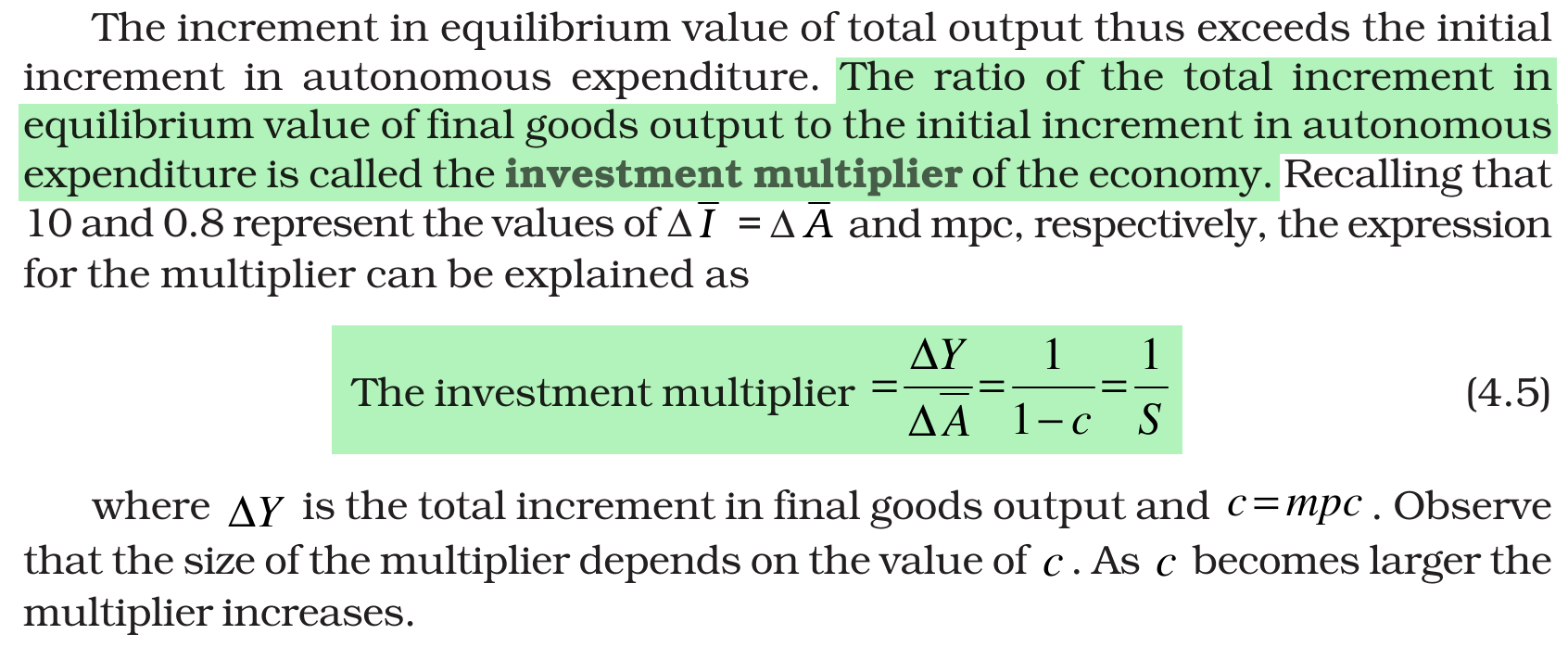
The investment multiplier (k) tells how many times income rises for each rupee of extra investment. Each round of new income is partly spent and partly saved. Only the part spent becomes someone’s income in the next round. So k depends on the marginal propensity to save (MPS = 1 − MPC):

k = 1/(1 − MPC)

k = 1/(1 − 0.8)

k = 1/0.2 = 5

NCERT (2026-27): Introductory Macroeconomics — Chapter 4: Determination of Income and Employment

NCERT extract

Advertisement

Practise more on Macro Economics: Determination of Income and Employment

Chapter-wise mocks on the real NTA exam screen, with solutions and your rank. Your first mocks are free.

Start free mocks →

Advertisement

Next questions

  1. Chemical formula of quick lime is __________.General Aptitude Test · General Knowledge
  2. Match the beginnings of the sentences in List-I with their correct endings in List-II.List-I (Beginnings)List-II (Endings)(A) Such was the…English · Grammar: Formation of Sentence
  3. Which Section of the Legal Services Authorities Act provides details of the High Court Legal Services Committee?Legal Studies · Legal Services
  4. Find the missing term in the given series.AZ, CX, FU, ___?___General Aptitude Test · Verbal Reasoning
  5. After the industrial revolution:1.Demand for raw materials slowed down.2.Monetary value of the raw materials increased in relation to the m…Geography · Fundamentals of Human Geography: International Trade
  6. In a terrestrial ecosystem, who are the primary producers?Biology · Ecosystem
  7. In a school of 200 students, the following chart represents the percentage of students involved in different sports. What is the number of…General Aptitude Test · Quantitative Reasoning
  8. Which of the following non-metal is lustrous?General Aptitude Test · General Knowledge
  9. Aman can do 50% of the job in 16 days, and Bhanu can do 25% of the job in 24 days. In how many days can they do 1/4 th of the job working t…General Aptitude Test · Numerical Ability
  10. Arrange the following in the decreasing order of basic strength in aqueous solution: A. CH_3NH_2 B. (CH_3)_3N C. (CH_3)_2NH D. NH_3 E. C_6H…Chemistry · Organic: Amines