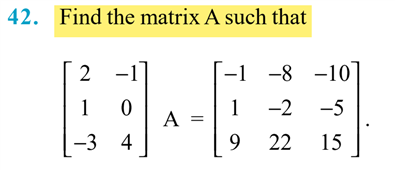
If \(\begin{bmatrix} 2 & -1\\ 1 & 0\\ -3 & 4\end{bmatrix} A= \begin{bmatrix} -1 & -8 & -10\\ 1 & -2 & -5\\ 9 & 22 & 15 \end{bmatrix}\), then matrix A is equal to:
Answer & explanation
Correct answer: option 3
The correct answer is Option (3) → \(\begin{bmatrix} 1 & -2 & -5\\ 3 & 4 & 0\end{bmatrix}\)
A 3 × 2 matrix times A gives a 3 × 3 matrix, so by the order rule A must be 2 × 3. This already rules out Options (2) and (4), which are 3 × 2.
Write the rows of A as \(R_1\) and \(R_2\). Row i of the product is (first entry of row i) × \(R_1\) + (second entry) × \(R_2\).
Row 2 of the product, from the row (1, 0):
\(1 \cdot R_1 + 0 \cdot R_2 = (1, -2, -5)\)
\(R_1 = (1, -2, -5)\)
Row 1 of the product, from the row (2, −1):
\(2R_1 - R_2 = (-1, -8, -10)\)
\(R_2 = (2, -4, -10) - (-1, -8, -10)\)
\(R_2 = (3, 4, 0)\)
Check with row 3, from the row (−3, 4):
\(-3(1, -2, -5) + 4(3, 4, 0) = (9, 22, 15)\), as given.
So
\( \displaystyle A = \begin{bmatrix} 1 & -2 & -5\\ 3 & 4 & 0\end{bmatrix} \)
NCERT Exemplar:
Matrices