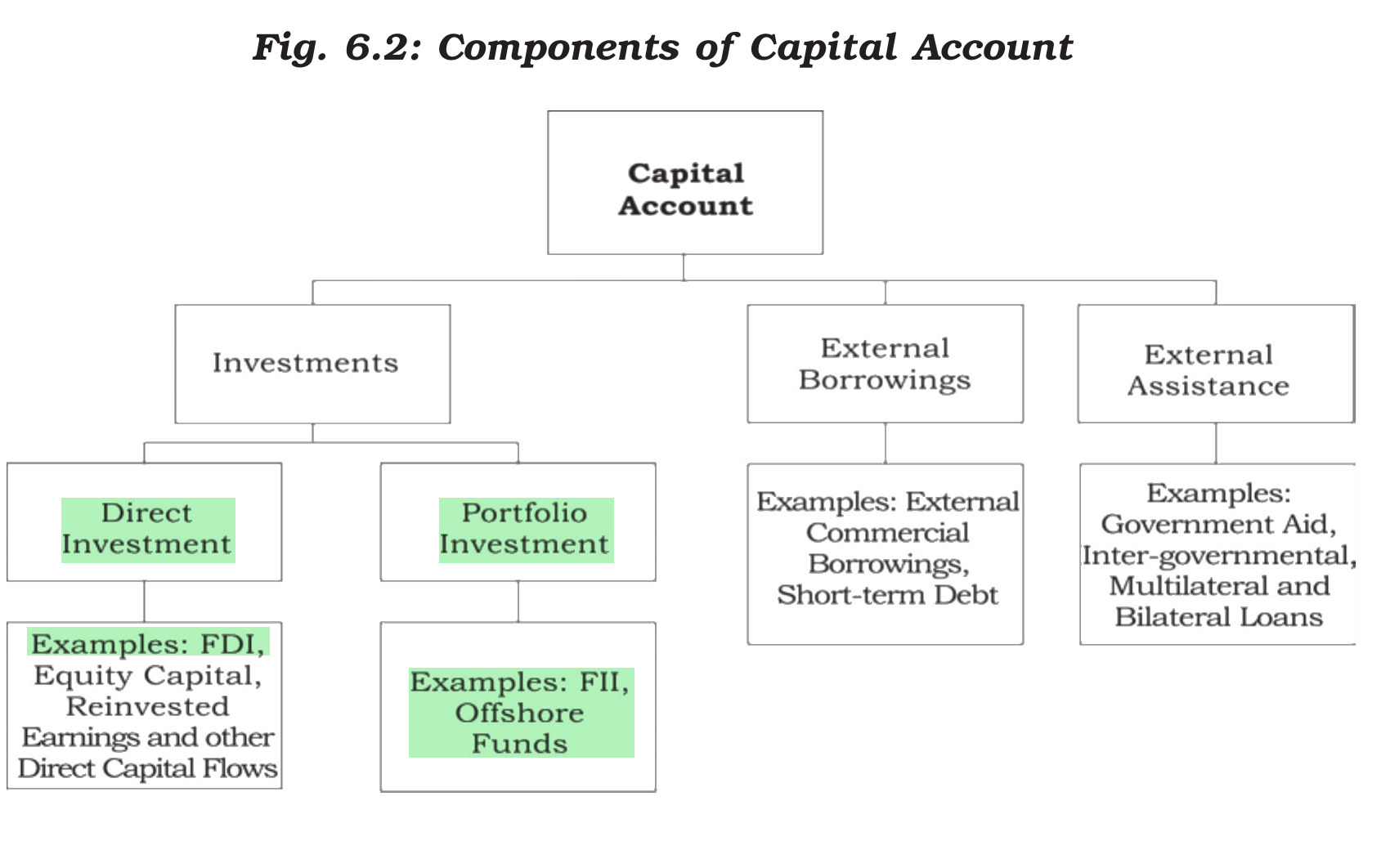
Which of the following are part of Capital account?
(A) Foreign Direct Investment.
(B) Offshore Funds.
(C) Portfolio Investment.
(D) Repayment of Loans.
Choose the correct answer from the options given below:
Answer & explanation
Correct answer: option 3
The correct answer is Option (3) → (A), (B), (C) and (D)
The capital account records a country’s international dealings in assets and loans. Money coming in is a capital inflow, and money going out is a capital outflow.
(A) Foreign Direct Investment. Correct. A foreigner buys assets to own a business in another country. An Indian buying a UK car company is an example. It is a purchase of assets across the border.
(B) Offshore Funds. Correct. These are investment funds based outside the country that buy its financial assets. They are an example of portfolio investment.
(C) Portfolio Investment. Correct. This is investment in shares, bonds and other financial assets of another country. It is one of the parts of foreign investment in the capital account.
(D) Repayment of Loans. Correct. Loans taken from abroad are a capital inflow. Paying them back is a capital outflow.
NCERT (2026-27): “6.1.2 Capital Account Capital Account records all international transactions of assets. An asset is any one of the forms in which wealth can be held, for example: money, stocks, bonds, Government debt, etc. Purchase of assets is a debit item on the capital account. If an Indian buys a UK Car Company, it enters capital account transactions as a debit item (as foreign exchange is flowing out of India). On the other hand, sale of assets like sale of share of an Indian company to a Chinese customer is a credit item on the capital account. Fig. 6.2 classifies the items which are a part of capital account transactions. These items are Foreign Direct Investments (FDIs), Foreign Institutional Investments (FIIs), external borrowings and assistance.… Balance on Capital Account Capital account is in balance when capital inflows (like receipt of loans from abroad, sale of assets or shares in foreign companies) are equal to capital outflows (like repayment of loans, purchase of assets or shares in foreign countries).…”
|