
An aeroplane can carry a maximum of 200 passengers. A profit of ₹500 is made on each executive class ticket out of which 20% will go to the welfare fund of the employees. Similarly a profit of ₹400 is made on each economy class ticket out of which 25% will go for the improvement of facilities provided to economy class passengers. In both cases, the remaining profit goes to the airline's fund. The airline reserves atleast 20 seats for executive class. However atleast four times as many passengers prefer to travel by economy class than by the executive class. Determine how many tickets of each type must be sold in order to maximise the net profit of the airline. Make the above as an L.P.P. and solve graphically.
Answer & explanation
Correct answer: option 1
The correct answer is Option (1) → ₹64,000
Let x be the number of executive class tickets sold and y be the number of economy class tickets sold, then total profit P (in ₹) = $500x + 400y$.
Hence, the problem can be formulated as an L.P.P. as follows:
Maximize $P = 500x + 400y$ subject to the constraints
$x + y ≤ 200$ (capacity constraint)
$x ≥ 20$ (executive class constraint)
$y ≥ 4x$ (economy class constraint)
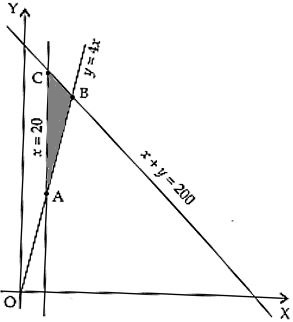
We draw the lines $x + y = 200, x = 20$ and $y = 4x$ and shade the region satisfied by the above inequalities.
The shaded portion shows the feasible region ABC which is bounded. The corner points of the feasible region ABC are A(20, 80), B(40, 160) and C(20, 180).
The optimal solution occurs at one of the corner points.
At $A(20, 80), P = 500 × 20 + 400 × 80 = 42000;$
at $B(40, 160), P =500 × 40 + 400 × 160 = 84000$ and
at $C(20, 180), P =500 × 20 + 400 × 180 = 82000$.
We find that the value of P is maximum at B(40, 160). Hence, maximum profit of ₹84000 is earned by selling 40 executive class tickets and 160 economy class tickets.
Net profit of airline = 80% of (500 x 40) + 75% of (400 x 160)
$=\frac{4}{5}× 20000 + \frac{3}{4} × 64000 = ₹64000$.