Read the passage carefully and answer the questions based on the passage:
Concept of Price Ceiling
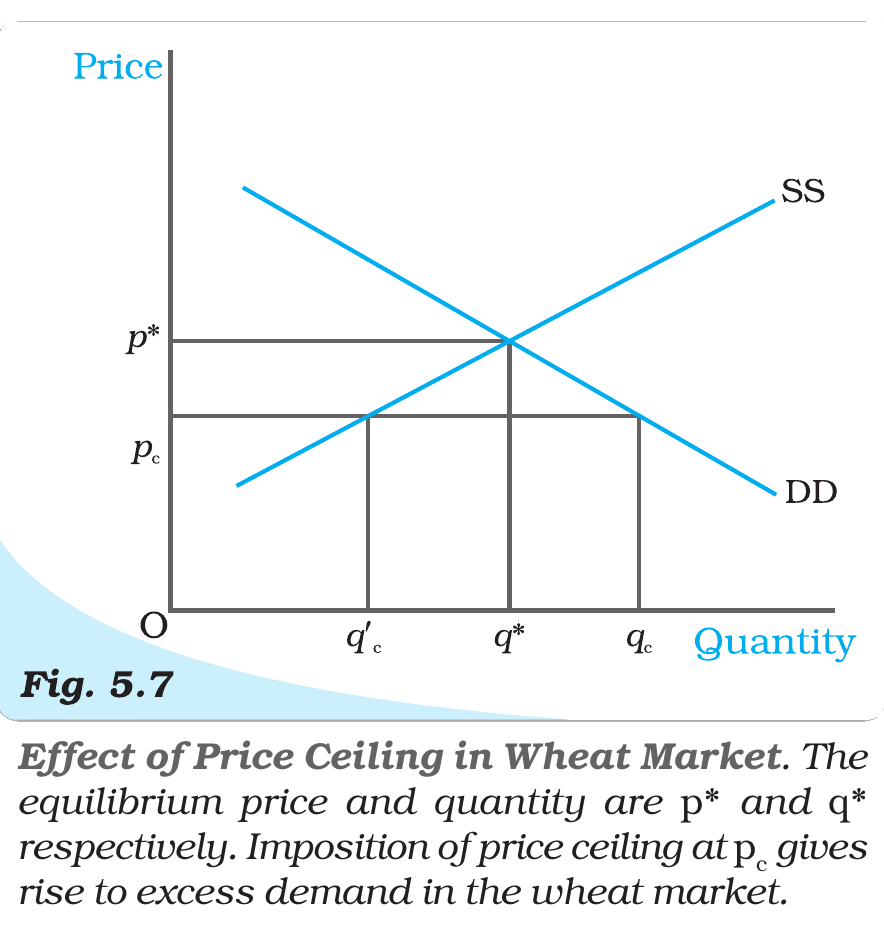
It is not very uncommon to come across instances where the government fixes a maximum allowable price for certain goods. The government-imposed upper limit on the price of a good or service is called a price ceiling. A price ceiling is generally imposed on necessary items like wheat, rice, kerosene, sugar etc. The objective of the price ceiling is to restrict the price of a good so that it becomes affordable for consumers to buy. However, it does not always generate the desired results. Most of the time, intervention by the government in the form of a price ceiling leads to various socio-problems.
The market determined price of a good is Rs. 40. The government determines the price ceiling on the good as Rs. 25. Calculate the excess demand/excess supply it will cause if the demand and supply functions are Qd = 200 - p and Qs = 120 + p respectively.
Answer & explanation
Correct answer: option 3
The correct answer is Option (3) → Excess demand for 30 units.
Given:
Market determined price = Rs. 40
Price ceiling = Rs. 25
Qd = 200 - p
Qs = 120 + p
A price ceiling set below the market price makes buyers want more than sellers offer. Find both quantities at Rs. 25:
Qd = 200 - 25 = 175
Qs = 120 + 25 = 145
Excess demand = Qd - Qs
Excess demand = 175 - 145 = 30 units
Note: The passage of this question is taken from the section ‘Price Ceiling’ of the chapter ‘Market Equilibrium’ of the NCERT book (Introductory Microeconomics). A few lines on price ceilings gave NTA a full set of questions, so read every short section with care.
NCERT (2026-27): “5.2.1 Price Ceiling It is not very uncommon to come across instances where government fixes a maximum allowable price for certain goods. The government-imposed upper limit on the price of a good or service is called price ceiling.… …The equilibrium price and quantity of wheat are p* and q* respectively. When the government imposes price ceiling at pc which is lower than the equilibrium price level, there will be an excess demand for wheat in the market at that price. The consumers demand qc kilograms of wheat whereas the firms supply qc′ kilograms.…”
|