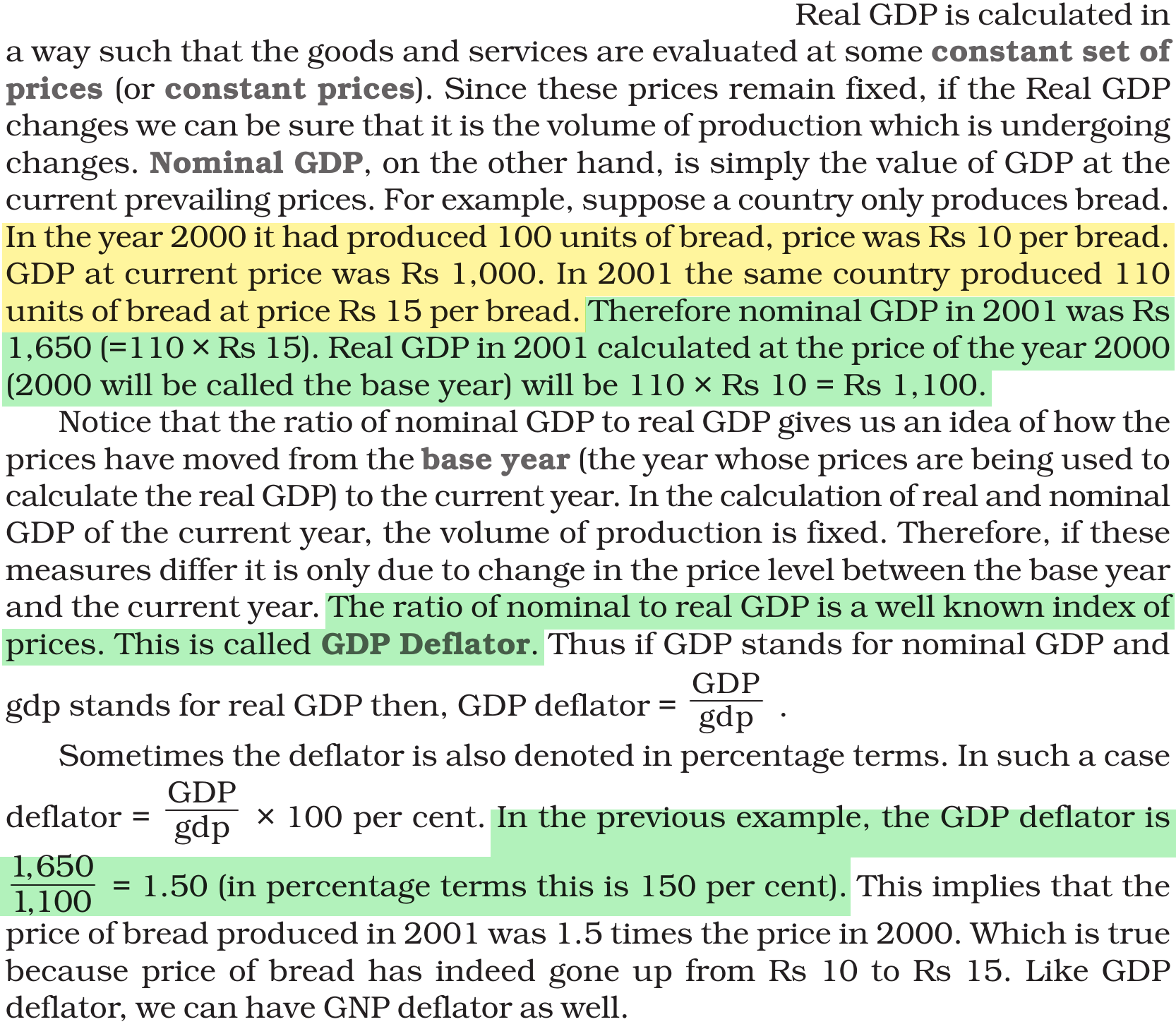
A country in the year 2000 produced 100 units of bread at price of Rs 10 per bread. GDP at current price was Rs 1,000. In 2001 the same country produced 110 units of bread at price Rs 15 per bread. What is the GDP deflator?
Answer & explanation
Correct answer: option 2
The correct answer is Option (2) → 150 percent.
Given:
Price in 2000 = Rs 10 per bread
Quantity in 2001 = 110 units
Price in 2001 = Rs 15 per bread
The GDP deflator is the ratio of nominal to real GDP, here in percentage terms. Nominal GDP uses the current year’s price. Real GDP uses the base year’s price, here that of 2000.
Nominal GDP of 2001 = 110 × 15 = Rs 1,650
Real GDP of 2001 = 110 × 10 = Rs 1,100
GDP deflator = (1,650 ÷ 1,100) × 100 = 150 per cent
So the price of bread in 2001 was 1.5 times its price in 2000.
Note: This question is the bread example on the GDP deflator in the chapter ‘National Income Accounting’ of the NCERT book, with the same quantities and prices.
NCERT (2026-27): Introductory Macroeconomics — Chapter 2: National Income Accounting
|