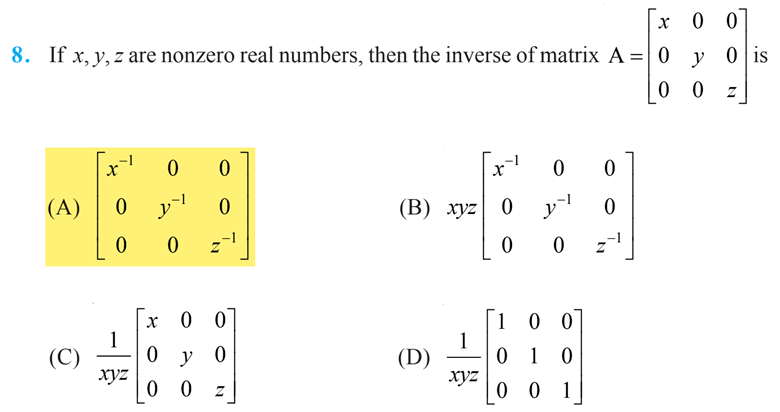
If x, y & z are non zero real numbers, the inverse of matrix \(A=\begin{bmatrix}x & 0 & 0\\ 0 & y & 0\\ 0 & 0 & z\end{bmatrix}\) is:
Answer & explanation
Correct answer: option 1
The correct answer is Option (1) → \(\begin{bmatrix}x^{-1} & 0 & 0\\ 0 & y^{-1} & 0\\ 0 & 0 & z^{-1}\end{bmatrix}\)
A is a diagonal matrix with \(|A|=xyz \ne 0\), so \(A^{-1}\) exists. The cofactors of the diagonal elements are yz, xz, xy and every other cofactor is 0:
\( \displaystyle \mathrm{adj}\,A=\begin{bmatrix}yz & 0 & 0\\ 0 & xz & 0\\ 0 & 0 & xy\end{bmatrix} \)
\( \displaystyle A^{-1}=\frac{1}{|A|}\,\mathrm{adj}\,A=\frac{1}{xyz}\begin{bmatrix}yz & 0 & 0\\ 0 & xz & 0\\ 0 & 0 & xy\end{bmatrix} \)
\( \displaystyle =\begin{bmatrix}x^{-1} & 0 & 0\\ 0 & y^{-1} & 0\\ 0 & 0 & z^{-1}\end{bmatrix} \)
Shortcut: Multiplying A by Option (1) gives the diagonal entries \(x\cdot x^{-1}=1\), \(y\cdot y^{-1}=1\), \(z\cdot z^{-1}=1\), that is, the identity matrix I. The inverse of a diagonal matrix is the diagonal of reciprocals.
Why the other options are incorrect
Option (2) \(xyz\begin{bmatrix}x^{-1} & 0 & 0\\ 0 & y^{-1} & 0\\ 0 & 0 & z^{-1}\end{bmatrix}\) — Incorrect. This equals diag(yz, xz, xy), which is adj A; it still has to be divided by |A| = xyz.
Option (3) \(\displaystyle\frac{1}{xyz}\begin{bmatrix}x^{-1} & 0 & 0\\ 0 & y^{-1} & 0\\ 0 & 0 & z^{-1}\end{bmatrix}\) — Incorrect. Multiplied by A it gives \(\frac{1}{xyz}I\), not I.
Option (4) \(\displaystyle\frac{1}{xyz}\begin{bmatrix}1 & 0 & 0\\ 0 & 1 & 0\\ 0 & 0 & 1\end{bmatrix}\) — Incorrect. Multiplied by A it gives diag\(\left(\frac{1}{yz}, \frac{1}{xz}, \frac{1}{xy}\right)\), not I.
NCERT (2026-27 edition):
Determinants