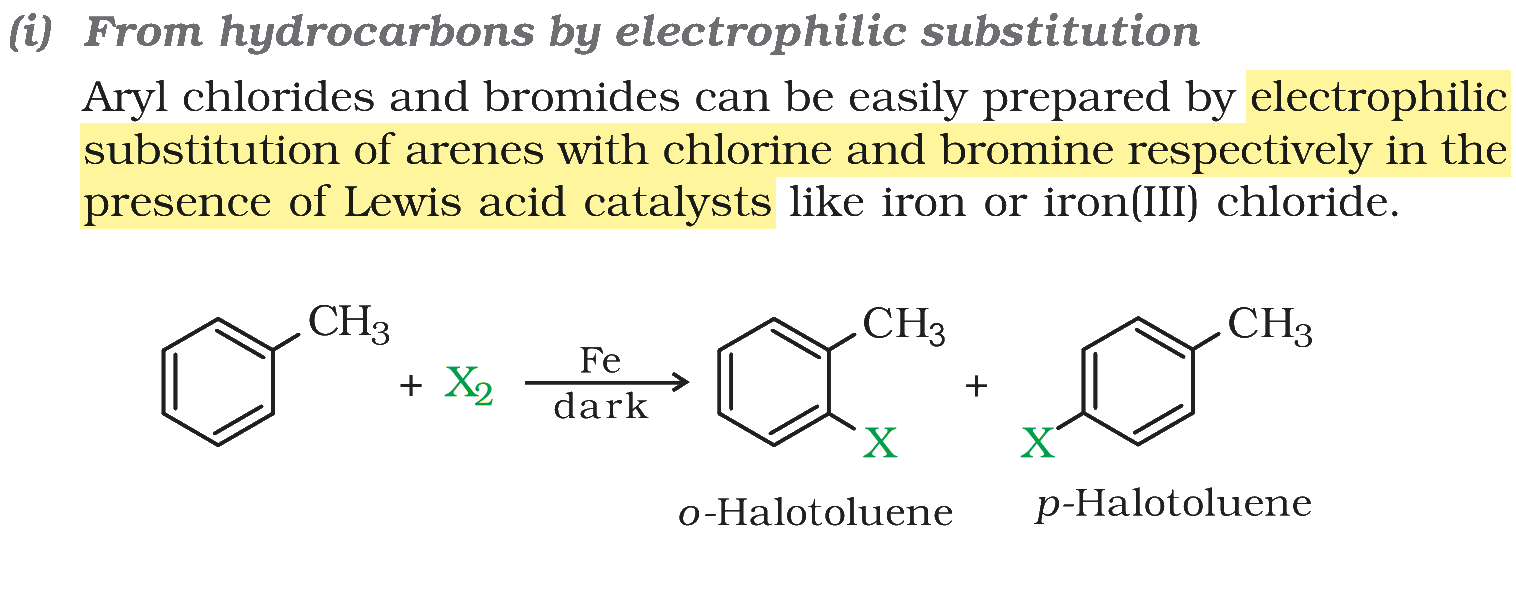
What is the product (s) formed when toluene reacts with \( Cl_2 \) in presence of anhydrous \( AlCl_3 \)?
Answer & explanation
Correct answer: option 3
The correct answer is Option (3) → ortho and para chlorotoluene
With chlorine, the conditions decide where toluene reacts. With a Lewis acid such as anhydrous \( \ce{AlCl3} \) (in the dark), the reaction is electrophilic substitution on the ring. \( \ce{AlCl3} \) polarises the chlorine molecule and generates the electrophile:
\( \displaystyle \ce{Cl2 + AlCl3 -> Cl^+ + [AlCl4]^-} \)
The methyl group is electron releasing and directs the electrophile to the ortho and para positions, so a mixture of both isomers forms:
\( \displaystyle \ce{C6H5CH3 + Cl2} \xrightarrow{\text{anhyd. }\ce{AlCl3}} o\text{-}\ce{ClC6H4CH3} + p\text{-}\ce{ClC6H4CH3} + \ce{HCl} \)
The two isomers are easily separated because their melting points differ a lot.
Why the other options are incorrect
Option (1) Benzyl Chloride — Incorrect. \( \ce{C6H5CH2Cl} \) is formed by side chain chlorination, which needs chlorine in light or at the boiling point, without a Lewis acid.
Option (2) Benzal Chloride — Incorrect. \( \ce{C6H5CHCl2} \) is also a side chain product, formed with more chlorine in light (as in Q14 of this paper).
Option (4) para Chlorotoluene — Incorrect. The para isomer is formed, but not alone; the ortho isomer forms along with it.
NCERT (2026-27 edition):
From Hydrocarbons by Electrophilic Substitution