Read the passage and answer the following question.
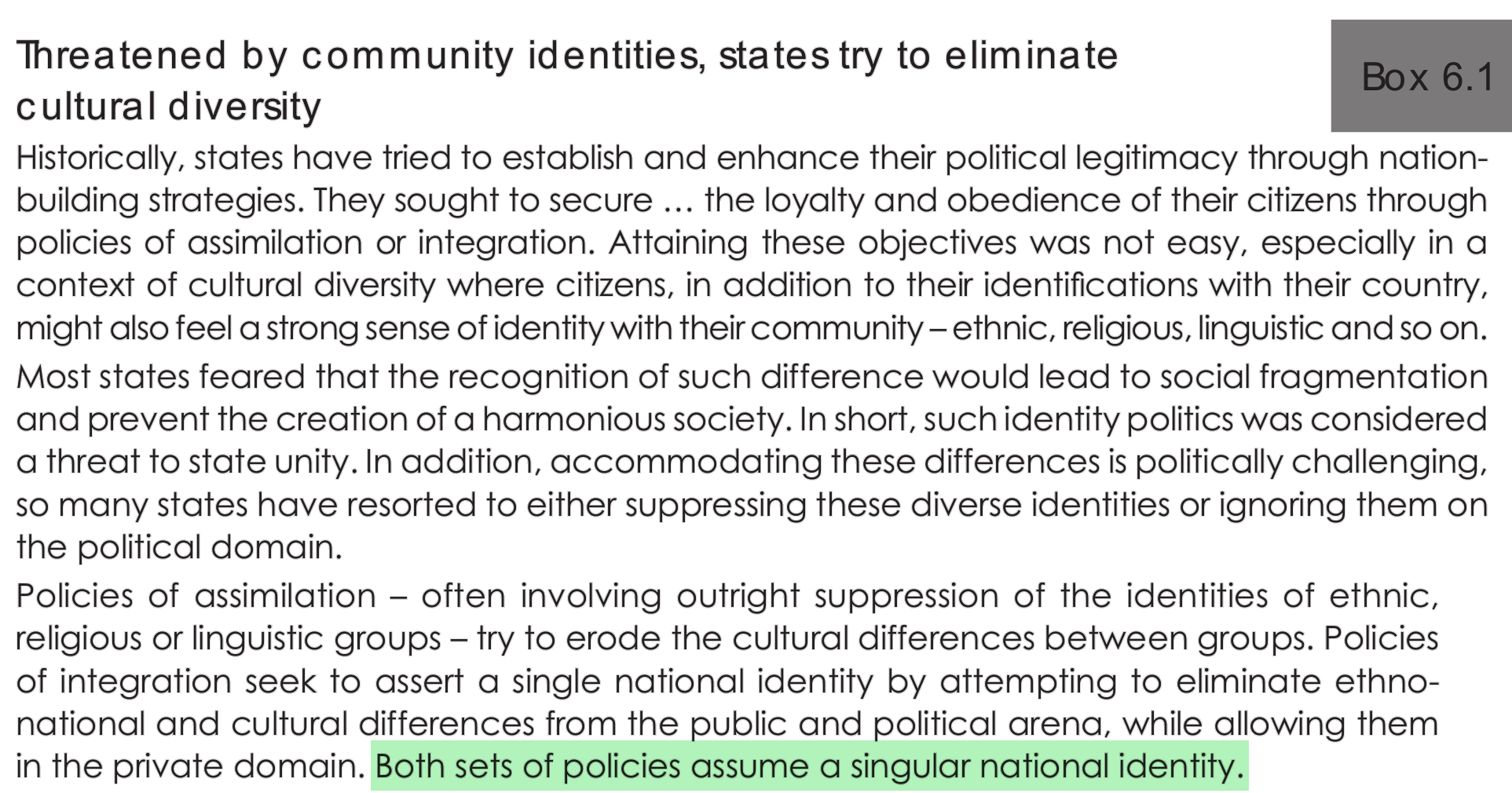
Historically, states have tried to establish and enhance their political legitimacy through nation-building strategies. They sought to secure... the loyalty and obedience of their citizens through policies of assimilation or integration. Attaining these objectives was not easy, especially in a context of cultural diversity where citizens, in addition to their identifications with their country, might also feel a strong sense of identity with their community - ethnic, religious, linguistic and so on. Most states feared that the recognition of such difference would lead to social fragmentation and prevent the creation of a harmonious society. In short, such identity politics was considered a threat to state unity. In addition, accommodating these differences is politically challenging so many states have resorted to either suppressing these diverse identities or ignoring them on the political domain.
Policies of assimilation-often involving outright suppression of the identities of ethnic, religious or linguistic groups-try to erode the cultural differences between groups. Policies of integration seek to assert a single national identity by attempting to eliminate ethno-national and cultural differences from the public and political arena, while allowing them in the private domain. Both sets of policies assume a singular national identity.
Assimilationist and integrationist strategies try to establish singular national identities through various interventions like :
- Centralising all power to forums where the dominant group constitutes a majority, and eliminating the autonomy of local or minority groups.
- Imposing a unified legal and judicial system based on the dominant group's traditions and abolishing alternative systems used by other groups.
- Adopting the dominant group's language as the only official 'national' language and making its use mandatory in all public institutions.
- Promotion of the dominant group's language and culture through national institutions including state-controlled media and educational institutions.
- Adoption of state symbols celebrating the dominant group's history, heroes and culture, reflected in such things as choice of national holidays or naming of streets etc.
- Seizure of lands, forests and fisheries from minority groups and indigenous people and declaring them 'national resources'....
Assimilationist and Integrationist strategies may be understood as:
Answer & explanation
Correct answer: option 1
The correct answer is Option (1) → Policies that assume singular national identities by overriding variations within populations.
Option (1) Policies that assume singular national identities by overriding variations within populations. — Correct. Policies of assimilation try to erode the cultural differences between groups, often by suppressing their identities. Policies of integration try to eliminate ethno-national and cultural differences from the public and political arena, while allowing them in the private domain. Both sets of policies assume a singular national identity, built on the dominant group’s language, laws and culture.
Option (2) Policies that allow divergent cultures of the population. — Incorrect. Allowing divergent cultures means letting the different cultures of a population live on and express themselves freely. Assimilationist and integrationist strategies do the opposite: they treat such differences as a threat to state unity and either suppress them or keep them out of the public and political arena.
Option (3) Policies that allow multiculturalism — Incorrect. Multiculturalism means many cultures living side by side, each recognised and accommodated in public life, as in a multicultural democracy. Assimilationist and integrationist strategies see such diversity as a threat to state unity and try to reduce it.
Option (4) Policies that allow minority protection — Incorrect. Minority protection means safeguards for groups that are fewer in number or weaker in power, such as the right to keep their own language, culture and institutions. Assimilationist strategies instead eliminate the autonomy of local or minority groups and may even seize their lands, forests and fisheries.
NCERT (2025-26): “Communities, Nations and Nation-States … Box 6.1 speaks of ‘assimilationist’ and ‘integrationist’ policies. Policies that promote assimilation are aimed at persuading, encouraging or forcing all citizens to adopt a uniform set of cultural values and norms. These values and norms are usually entirely or largely those of the dominant social group. Other, non-dominant or subordinated groups in society are expected or required to give up their own cultural values and adopt the prescribed ones. Policies promoting integration are different in style but not in overall objective: they insist that the public culture be restricted to a common national pattern, while all ‘non-national’ cultures are to be relegated to the private sphere. In this case too, there is the danger of the dominant group’s culture being treated as ‘national’ culture.…”
Box 6.1, Threatened by community identities, states try to eliminate cultural diversity |