Arrange the agricultural development of India in chronological order from Independence to the present day:
(A) Green Revolution
(B) Agro-Climatic Planning
(C) Intensive Agricultural District Programme
(D) National Mission for Sustainable Agriculture
Choose the correct answer from the options given below:
Answer & explanation
Correct answer: option 1
The correct answer is Option (1) → (C), (A), (B), (D)
(C) Intensive Agricultural District Programme — first. It was launched when farm production stagnated in the late 1950s.
(A) Green Revolution — second. High yielding seeds came by the mid-1960s, and foodgrain output rose very fast.
(B) Agro-Climatic Planning — third. The Planning Commission started it in 1988 for balanced growth of farming in all regions.
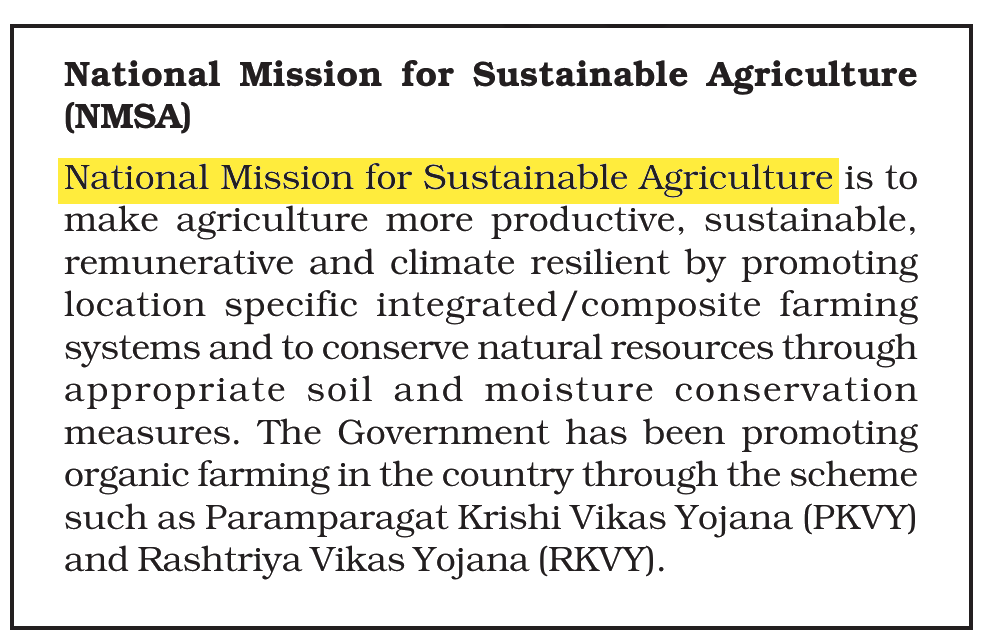
(D) National Mission for Sustainable Agriculture — last. It is a recent mission, after the liberalisation of the 1990s, to make farming sustainable and climate resilient.
Note: A similar question was also asked in CUET (UG) 2025 on 26-05-2025 (Slot 1).
NCERT (2026-27): “Agricultural Development in India … Initially, this strategy helped in increasing foodgrains production. But agricultural production stagnated during late –1950s. To overcome this problem, Intensive Agricultural District Programme (IADP) and Intensive Agricultural Area Programme (IAAP) were launched.” “New seed varieties of wheat (Mexico) and rice (Philippines) known as high yielding varieties (HYVs) were available for cultivation by mid-1960s. … This spurt of agricultural growth came to be known as ‘Green Revolution’.” “The Planning Commission of India focused its attention on the problems of agriculture in rainfed areas in 1980s. It initiated agro-climatic planning in 1988 to induce regionally balanced agricultural development in the country.” “Initiation of the policy of liberalisation and free market economy in 1990s influenced the course of development of Indian agriculture.”
Box: National Mission for Sustainable Agriculture (NMSA) |