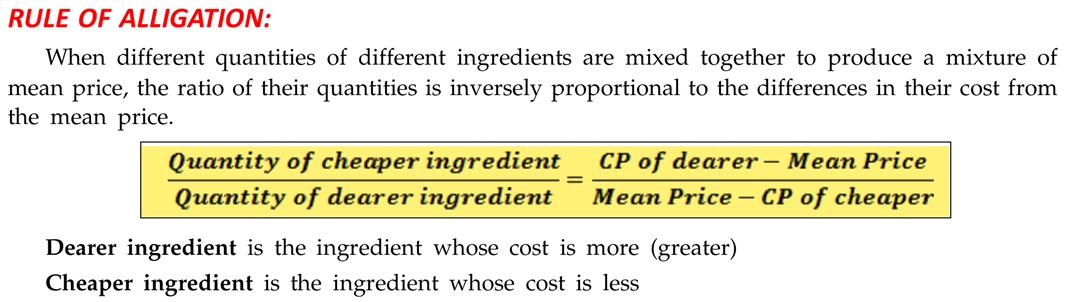
In context of Alligation and mixture the ratio of quantity of cheaper ingredient to the quantity of dearer ingredient =
Answer & explanation
Correct answer: option 3
The correct answer is Option (3) → \(\displaystyle\frac{\text{C.P. of dearer}-\text{Mean price}}{\text{Mean price}-\text{C.P. of cheaper}}\)
Let c and d be the cost prices of the cheaper and dearer ingredients, m the mean price, and mix quantities \(q_c\) and \(q_d\). The gain on the cheaper part balances the loss on the dearer part:
\(q_c(m-c) = q_d(d-m)\)
\(\displaystyle \frac{q_c}{q_d} = \frac{d-m}{m-c}\)
This is the rule of alligation: cheaper : dearer = (C.P. of dearer − Mean price) : (Mean price − C.P. of cheaper).
Why the other options are incorrect
Option (1) \(\displaystyle\frac{\text{Mean price}-\text{C.P. of dearer}}{\text{Mean price}-\text{C.P. of cheaper}}\) — Incorrect. The mean price is below the dearer price, so its numerator is negative; a ratio of quantities cannot be negative.
Option (2) \(\displaystyle\frac{\text{Mean price}-\text{C.P. of cheaper}}{\text{C.P. of dearer}-\text{Mean price}}\) — Incorrect. This is the reciprocal: it gives dearer : cheaper.
Option (4) \(\displaystyle\frac{\text{C.P. of cheaper}}{\text{C.P. of dearer}}\) — Incorrect. It does not involve the mean price at all, so it cannot fix the mixture.
CBSE Applied Mathematics (Class XII):
Alligation and Mixture