
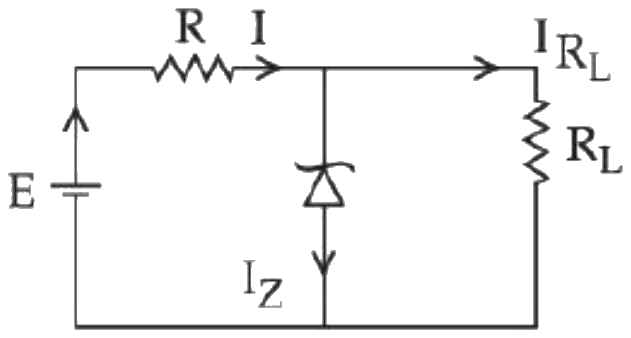
A zener diode having \( V_z = 12\,\mathrm{V} \) and \( I_{Z(\max)} = 40\,\mathrm{mA} \) is used in a voltage regulator circuit with unregulated power supply giving E = 19 V as shown in the circuit diagram shown below. The minimum value of the series resistor R required when the load resistance of \( 400\,\Omega \) is connected across the zener diode, so that the zener should not burn out, will be:
Answer & explanation
Correct answer: option 1
The correct answer is Option (1) → \( 100\,\Omega \)
In the zener regulator the zener diode holds the load voltage at \( V_z = 12\,\mathrm{V} \). The current through R divides between the zener and the load, so \( I = I_Z + I_L \). The series resistor is smallest when the zener current is at its maximum allowed value.
Current through the load:
\( \displaystyle I_L = \frac{V_z}{R_L} = \frac{12\,\mathrm{V}}{400\,\Omega} = 0.03\,\mathrm{A} = 30\,\mathrm{mA} \)
Largest current allowed through R:
\( I = I_{Z(\max)} + I_L = 40\,\mathrm{mA} + 30\,\mathrm{mA} = 70\,\mathrm{mA} = 0.07\,\mathrm{A} \)
The voltage across R is the supply voltage minus the zener voltage:
\( \displaystyle R_{\min} = \frac{E - V_z}{I} = \frac{19\,\mathrm{V} - 12\,\mathrm{V}}{0.07\,\mathrm{A}} = 100\,\Omega \)
A smaller R would push the zener current above 40 mA and burn it out.