The products formed at the cathode and anode by electrolysis of aqueous NaCl solution respectively are
Answer & explanation
Correct answer: option 3
The correct answer is Option (3) → H2, Cl2
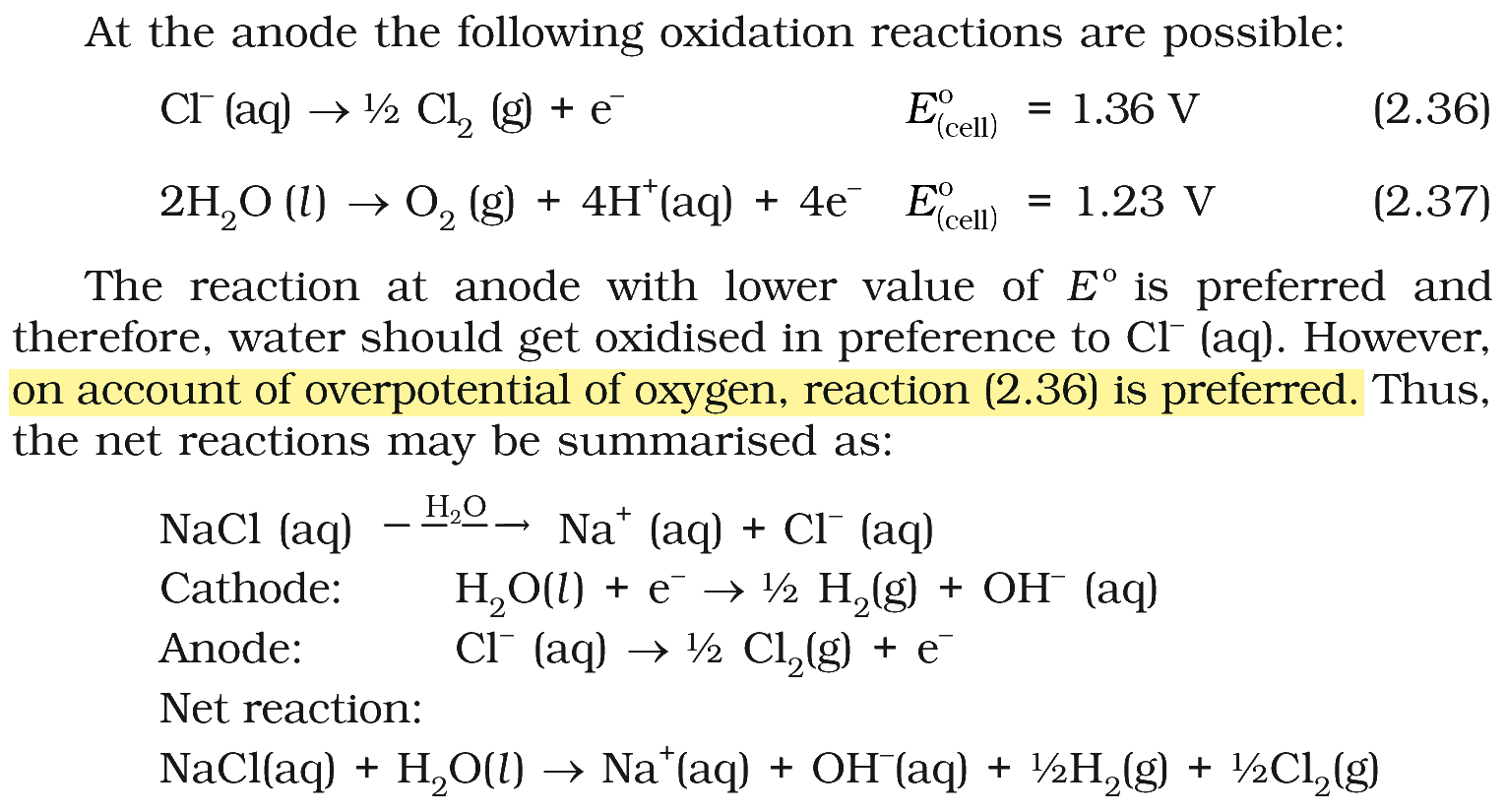
In aqueous NaCl there are \( \ce{Na^{+}} \), \( \ce{Cl^{-}} \) and water molecules, and each electrode discharges the species that is reduced or oxidised more easily.
At the cathode water is reduced in preference to \( \ce{Na^{+}} \), because E° of \( \ce{H2O} \)/\( \ce{H2} \) (−0.83 V) is far higher than that of \( \ce{Na^{+}} \)/Na (−2.71 V):
\( \ce{H2O(l) + e- -> 1/2H2(g) + OH-} \)
At the anode the oxidation of water to \( \ce{O2} \) has the lower E°, but because of the overpotential of oxygen chlorine is liberated:
\( \ce{Cl- -> 1/2Cl2(g) + e-} \)
Why the other options are incorrect
Option (1) Na, Cl2 — Incorrect. These are the products of electrolysis of molten NaCl; in water, \( \ce{H2} \) is formed at the cathode instead of sodium.
Option (2) Na, O2 — Incorrect. Sodium is not discharged from aqueous solution, and oxygen is not evolved because of its overpotential.
Option (4) H2, O2 — Incorrect. The cathode product is right, but the overpotential of oxygen makes \( \ce{Cl2} \), not \( \ce{O2} \), the anode product.
NCERT (2026-27 edition):
Products of Electrolysis – …