
In ΔABC, F and E are the points on sides AB and AC, respectively, such that FE ll BC and FE divides the triangle in two parts of equal area. If AD ⊥ BC and AD intersects FE at G, then GD : AG = ?
Answer & explanation
Correct answer: option 3
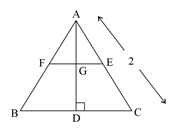
Similar triangle Theorem applied
ΔAGE ∼ ΔADC
(\(\frac{AG}{AD}\))2 = \(\frac{ar.\;of\;ΔAGE}{ar.\;of\;ΔADC}\) = \(\frac{1}{2}\)
\(\frac{AG}{AD}\) = \(\frac{1}{\sqrt {2}}\)
[Area of ΔAEF = area of quadrilateral FECD, similarly; [Area of ΔAGE = area of quadrilateral GECD = 1 Unit]
GD = AD - AG = \(\sqrt {2}\) - 1
\(\frac{AG}{GD}\) = \(\frac{1}{\sqrt {2} - 1}\)
GD : AG = ( \(\sqrt {2}\) - 1) : 1