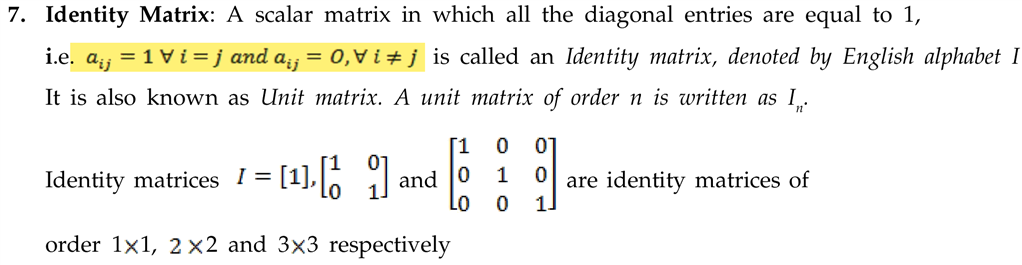
An identity matrix can be written as \([a_{ij}]_{n\times n}\) where,
Answer & explanation
Correct answer: option 2
The correct answer is Option (2) → \(a_{ij}=\begin{cases}0, & \text{when } i\ne j\\ 1, & \text{when } i=j\end{cases}\)
An identity matrix is a square matrix in which every diagonal entry (i = j) is 1 and every other entry (i ≠ j) is 0, for example
\( \displaystyle I_3 = \begin{bmatrix}1 & 0 & 0\\0 & 1 & 0\\0 & 0 & 1\end{bmatrix} \)
Why the other options are incorrect
Option (1) \(a_{ij}=\begin{cases}0, & \text{when } i\ne j\\ k, & \text{when } i=j\end{cases}\) — Incorrect. This is a scalar matrix; it is the identity matrix only when k = 1.
Option (3) \(a_{ij}=\begin{cases}k, & \text{when } i\ne j\\ 0, & \text{when } i=j\end{cases}\) — Incorrect. Its diagonal entries are 0, not 1.
Option (4) \(a_{ij}=\begin{cases}1, & \text{when } i\ne j\\ 0, & \text{when } i=j\end{cases}\) — Incorrect. The 1s and 0s are the wrong way round: the diagonal is 0 and every other entry is 1.
CBSE Applied Mathematics (Class XII):
Types of Matrices