
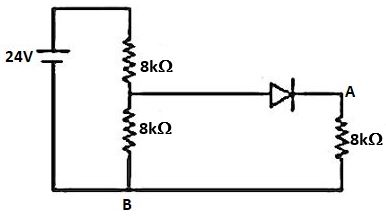
In the figure potential difference between A and B is:
Answer & explanation
Correct answer: option 4
The correct answer is Option (4) → 8 V
The upper terminal of the 24 V battery is positive, so the diode is in forward bias. An ideal diode in forward bias has zero resistance and no voltage drop, so it behaves like a plain wire and A is at the same potential as the junction of the two left-hand resistors.
The lower 8 kΩ resistor on the left and the 8 kΩ resistor on the right (through the diode) are in parallel between that junction and B.
\( \displaystyle R_{\parallel} = \frac{8\times8}{8+8}\,\mathrm{k\Omega} = 4\,\mathrm{k\Omega} \)
This is in series with the upper 8 kΩ resistor.
\( R_{\mathrm{total}} = 8\,\mathrm{k\Omega} + 4\,\mathrm{k\Omega} = 12\,\mathrm{k\Omega} \)
\( \displaystyle I = \frac{24\,\mathrm{V}}{12\,\mathrm{k\Omega}} = 2\,\mathrm{mA} \)
The potential difference across the parallel part, which is \( V_A - V_B \):
\( V_A - V_B = 2\,\mathrm{mA}\times4\,\mathrm{k\Omega} = 8\,\mathrm{V} \)