Which of the following is correct?
Answer & explanation
Correct answer: option 3
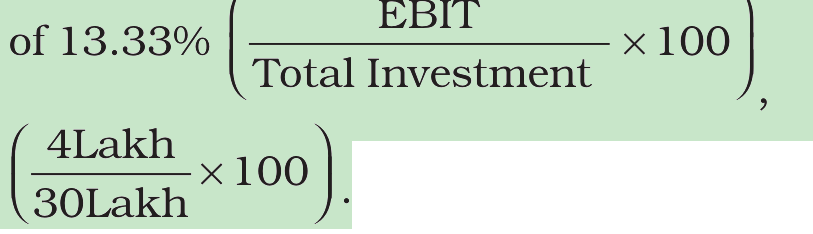
The correct answer is Option (3) → Return on investment is EBIT divided by total investment, multiplied by 100
Option (1) The primary aim of financial management is to maximise the profit of the company — False. The primary aim is to maximise shareholders’ wealth, that is, the market value of the equity shares.
Option (2) Dividend decision determines the overall cost of capital and the financial risk of a firm — False. It is the financing decision that sets the cost of capital of the firm as a whole and its financial risk. The dividend decision is about how much profit is paid out and how much is kept.
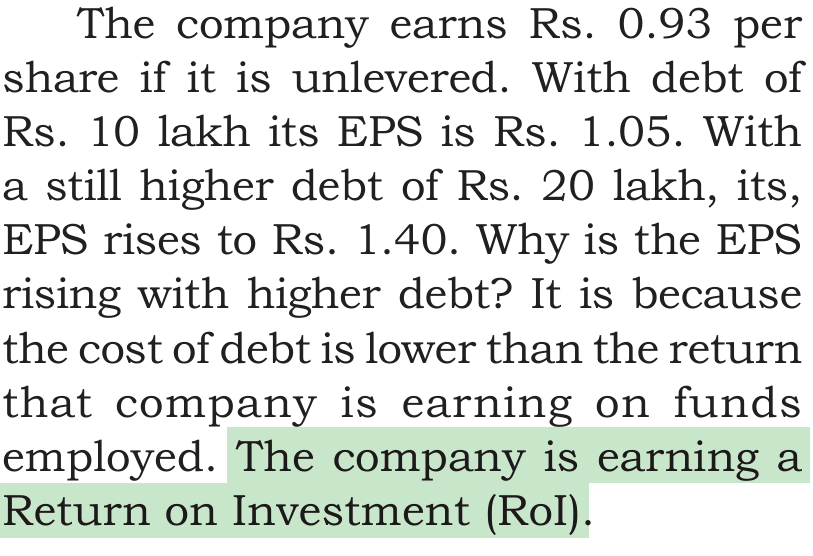
Option (3) Return on investment is EBIT divided by total investment, multiplied by 100 — True. RoI shows the return a company earns on the funds it uses. It is EBIT ÷ Total Investment × 100. With EBIT of Rs. 4 lakh on Rs. 30 lakh, RoI is 13.33%.
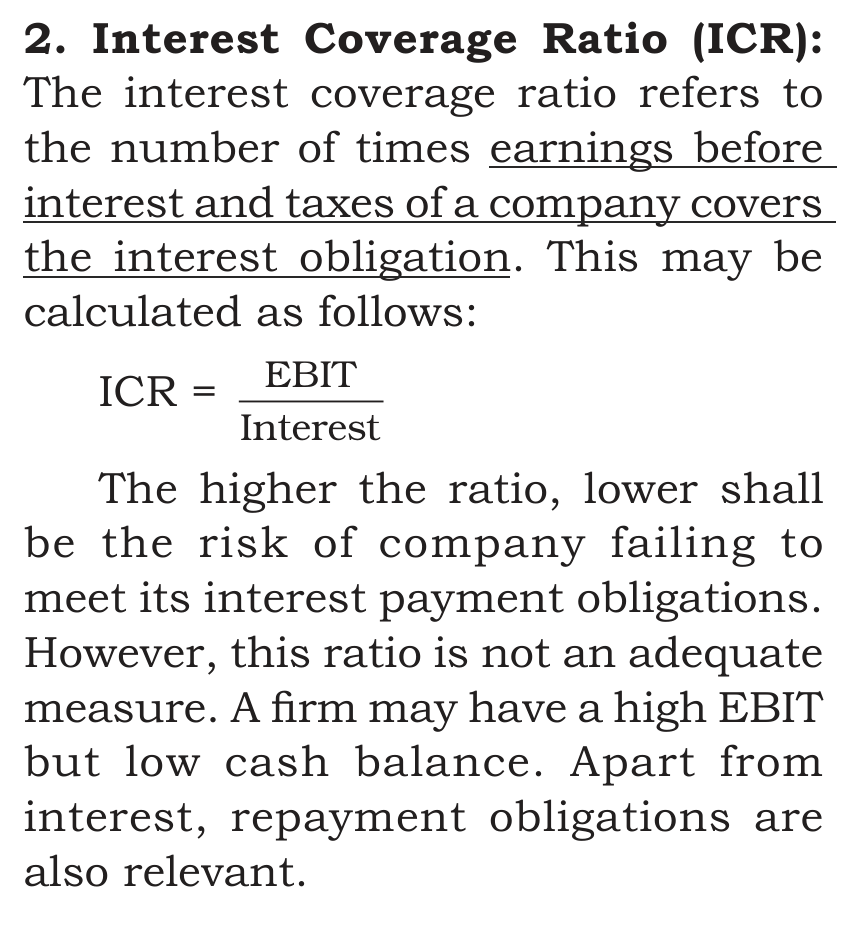
Option (4) Interest coverage ratio is earnings after tax divided by the interest obligation — False. The interest coverage ratio uses earnings before interest and taxes (EBIT). ICR = EBIT ÷ Interest.
NCERT (2026-27 Edition): “Objectives The primary aim of financial management is to maximise shareholders’ wealth, which is referred to as the wealth-maximisation concept. The market price of a company’s shares is linked to the three basic financial decisions which you will study a little later. This is because a company funds belong to the shareholders and the manner in which they are invested and the return earned by them determines their market value and price. It means maximisation of the market value of equity shares. …” “Financing Decision … Financing decision is, thus, concerned with the decisions about how much to be raised from which source. This decision determines the overall cost of capital and the financial risk of the enterprise. …” “EBIT-EPS Analysis … Three situations are considered. There is no debt in situation-I i.e. (unlevered business). Debt of Rs. 10 lakh and 20 lakh are assumed in situations-II and III, respectively. All debt is at 10% p.a. …”
|