Answer the question on the basis of passage given below:
Alcohols and phenols are formed when a hydrogen atom in a hydrocarbon, aliphatic and aromatic respectively, is replaced by –OH group. The substitution of a hydrogen atom in a hydrocarbon by an alkoxy or aryloxy group forms ethers.
Alcohols and phenols consist of two parts, an alkyl/aryl group and a hydroxyl group. The properties of alcohols and phenols are primarily due to the hydroxyl group. The nature of alkyl and aryl groups simply modifies these properties. Alcohols react both as nucleophiles and electrophiles whereas in phenols, the reactions that take place on the aromatic ring are electrophilic substitution reactions.
In the following reaction, compounds \(A\) and \(C\) are:

Answer & explanation
Correct answer: option 2
The correct answer is Option (2) → Positional Isomers
First, the Grignard reagent adds to the C=O of ethanal and hydrolysis gives a secondary alcohol, A = propan-2-ol:
\( \ce{CH3CHO + CH3MgBr} \xrightarrow{\text{dry ether}} \ce{(CH3)2CH-OMgBr} \xrightarrow{\ce{H2O}} \ce{(CH3)2CHOH} \text{ (A)} + \ce{Mg(OH)Br} \)
Next, conc. \( \ce{H2SO4} \) on heating dehydrates A to the alkene, B = propene:
\( \ce{(CH3)2CHOH} \xrightarrow[\Delta]{\text{conc. }\ce{H2SO4}} \ce{CH3CH=CH2 (B) + H2O} \)
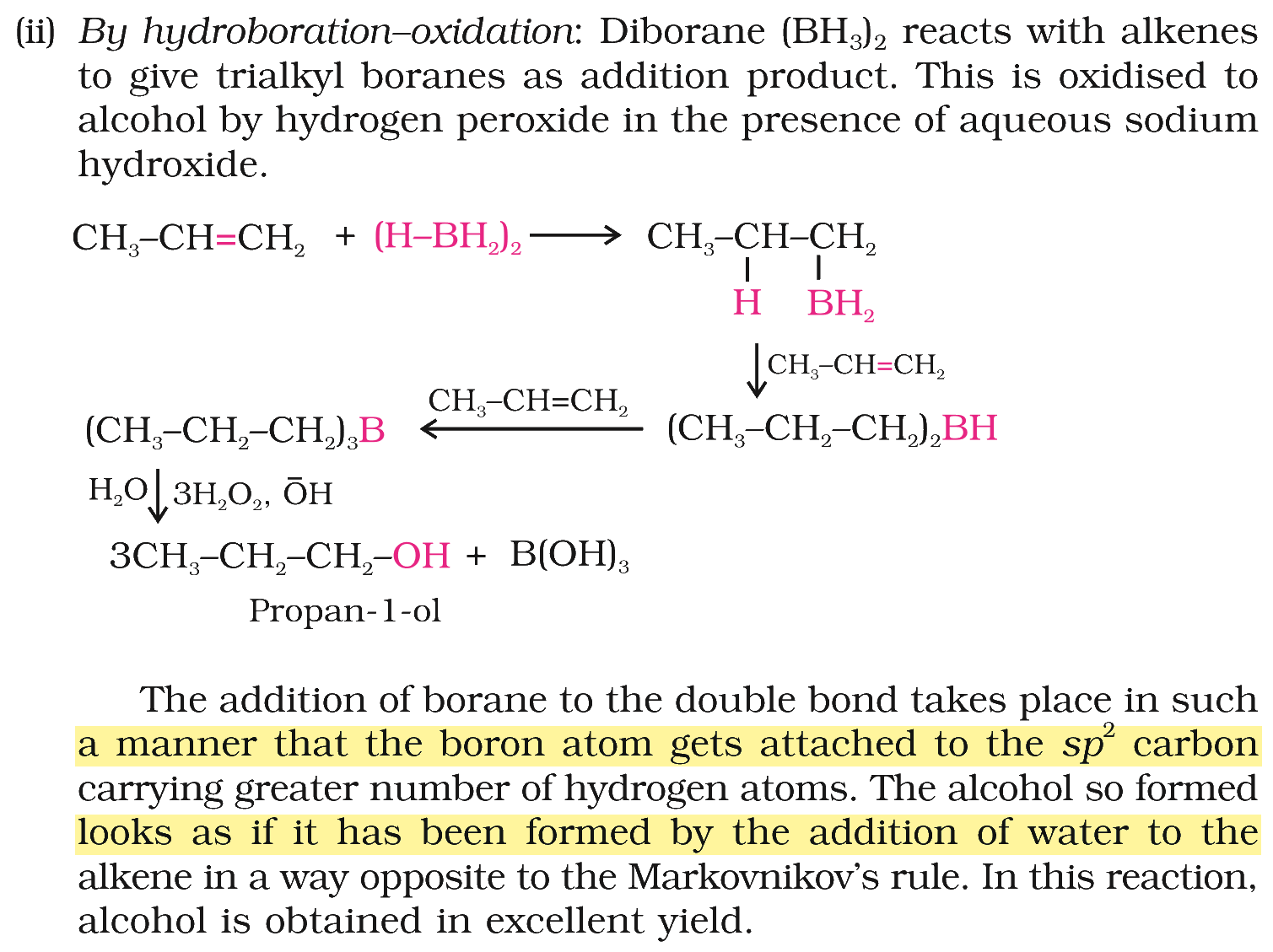
Finally, hydroboration–oxidation adds water across the double bond in the anti-Markovnikov way, the OH going to the terminal carbon, so C = propan-1-ol:
\( \ce{CH3CH=CH2 + (H-BH2)2 -> (CH3CH2CH2)3B} \xrightarrow[\ce{OH-}]{\ce{H2O2}} \ce{3CH3CH2CH2OH (C) + B(OH)3} \)
A (propan-2-ol) and C (propan-1-ol) have the same molecular formula \( \ce{C3H8O} \) and the same functional group, differing only in the position of the OH group: they are positional isomers.
Why the other options are incorrect
Option (1) Identical — Incorrect. Hydroboration–oxidation does not regenerate propan-2-ol; acid-catalysed hydration (Markovnikov) would.
Option (3) Functional Isomers — Incorrect. Both A and C are alcohols; a functional isomer of them would be an ether, \( \ce{CH3OC2H5} \).
Option (4) Optical Isomers — Incorrect. Neither propan-2-ol nor propan-1-ol has a chiral carbon, so neither is optically active.
NCERT (2026-27 edition):
By Hydroboration-Oxidation