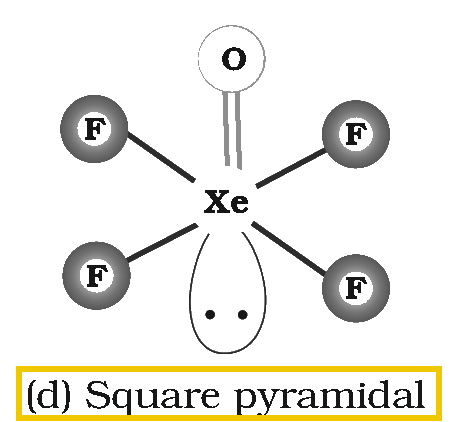
The shape and type of hybridization of \(XeOF_4\) according to VSEPR theory is:
Answer & explanation
Correct answer: option 4
The correct answer is Option (4) → square pyramidal, \(sp^3d^2\)
In \( \ce{XeOF4} \) xenon has 8 valence electrons. It forms one Xe=O bond and four Xe–F bonds and keeps one lone pair, so there are six electron pairs (five bond pairs and one lone pair) around Xe. Six electron pairs need sp3d2 hybridisation (octahedral arrangement); with one position taken by the lone pair, the shape is square pyramidal.
Why the other options are incorrect
Option (1) Square bipyramidal, \(sp^3d^2\) — Incorrect. The hybridisation is right, but a bipyramid would need six atoms round Xe; one of the six positions holds a lone pair, so the shape is a single square pyramid.
Option (2) Square planar, \(sp^3\) — Incorrect. Square planar is the shape of \( \ce{XeF4} \) (four bond pairs, two lone pairs, sp3d2); sp3 gives only four positions, too few for six pairs.
Option (3) pyramidal, \(sp^3\) — Incorrect. Pyramidal with sp3 is the shape of \( \ce{XeO3} \) (three bond pairs, one lone pair), not of \( \ce{XeOF4} \).
Note: This question is from the pre-rationalised NCERT book (2022-23). The topic is not there in the latest NCERT book (2026-27), and it is also out of the CUET 2026 syllabus.
NCERT (Pre-rationalised edition, 2022-23):
Xenon-Oxygen Compounds – “Partial hydrolysis of XeF6 gives oxyfluorides, XeOF4 and XeO2F2. XeF6 + H2O → XeOF4 + 2 HF. XeO3 is a colourless explosive solid and has a pyramidal molecular structure (Fig. 7.9). XeOF4 is a colourless volatile liquid and has a square pyramidal molecular structure (Fig. 7.9).”