CUETMOCK
  • Pricing
  • Mentors
Log inStart freeStart free mocks→

First test, then trust

Try a free CUET mock test.

Join 5,00,000+ students who rehearsed exam day on the exact NTA screen before sitting CUET. On the web and on Android.

Start free mocks →Get the Android app
CUETMOCK

India's #1 CUET Mock Test Platform. Original NCERT-based questions on the exact NTA exam screen — trusted by 5,00,000+ students since CUET 2022.

Get it onGoogle PlayScan to download the CUETMOCK app

Mock tests

  • CUET mock test series
  • Browse all papers
  • Commerce mocks
  • Humanities (Arts) mocks
  • Science mocks
  • Languages & GAT mocks
  • Free practice questions
  • Pricing

Resources

  • CUET exam guide
  • CUET syllabus
  • Universities accepting CUET
  • Expert blogs
  • News & notifications
  • Webinars & counselling
  • CUET score calculator
  • How we estimate your rank
  • FAQs

Company

  • About us
  • Our leadership & team
  • Our toppers
  • Mentors
  • For schools
  • Contact us
  • Terms
  • Privacy
  • Refund policy

Talk to us

+91 7696 6630 56info@cuetmock.comWhatsApp us

Our other platforms

  • JEE Mock — For IIT-JEE aspirants
  • NEET Mock — For NEET aspirants

Newsletter

Exam updates, study material and offers — no spam.

© 2026 NYC Ventures Pvt. Ltd.

701-702, Royal Business Park, Zirakpur, Punjab - 140603

  • Terms of use
  • Privacy policy
  • Refund policy
  • Contact us

iCUETMOCK is an independent preparation platform, not affiliated with the National Testing Agency (NTA). Always check exam details on the official NTA website.

  • Home
  • Mock tests
  • CUET guide
  • Pricing
  • Log in
Home/Practice questions/Economics
EconomicsMicro Economics: Theory of Firms under Perfect Competition

Match List-I with List-IIList-IList-II(A) The minimum level of profit…

Match List-I with List-II

List-IList-II
(A) The minimum level of profit that is needed to keep a firm in the existing business.(I) Super-normal profit
(B) Profit that a firm earns over and above the normal profit.(II) Loss
(C) AR < AC(III) Break even point
(D) The point of minimum average cost at which the supply curve cuts the AC curve.(IV) Normal Profit

Choose the correct answer from the options given below:

Answer & explanation+

Correct answer: option 2

The correct answer is Option (2) → (A)-(IV), (B)-(I), (C)-(II), (D)-(III)

A firm’s profit is judged against its costs. Normal profit is itself treated as a part of total cost, because it is what keeps the owner in the business.

List-IList-IIReason
(A) The minimum level of profit that is needed to keep a firm in the existing business.(IV) Normal ProfitA firm that does not make this profit will not continue in business in the long run.
(B) Profit that a firm earns over and above the normal profit.(I) Super-normal profitThis is the extra profit beyond normal profit.
(C) AR < AC(II) LossAverage revenue (AR) is revenue per unit, and average cost (AC) is cost per unit. If AR is less, each unit is sold at a loss.
(D) The point of minimum average cost at which the supply curve cuts the AC curve.(III) Break even pointAt this point the firm earns only normal profit, so it just covers its costs.

NCERT (2026-27): “4.4.4 The Normal Profit and Break-even Point The minimum level of profit that is needed to keep a firm in the existing business is defined as normal profit. A firm that does not make normal profits is not going to continue in business. Normal profits are therefore a part of the firm’s total costs. It may be useful to think of them as an opportunity cost for entrepreneurship. Profit that a firm earns over and above the normal profit is called the super-normal profit. In the long run, a firm does not produce if it earns anything less than the normal profit. In the short run, however, it may produce even if the profit is less than this level. The point on the supply curve at which a firm earns only normal profit is called the break-even point of the firm. The point of minimum average cost at which the supply curve cuts the LRAC curve (in short run, SAC curve) is therefore the break-even point of a firm.…

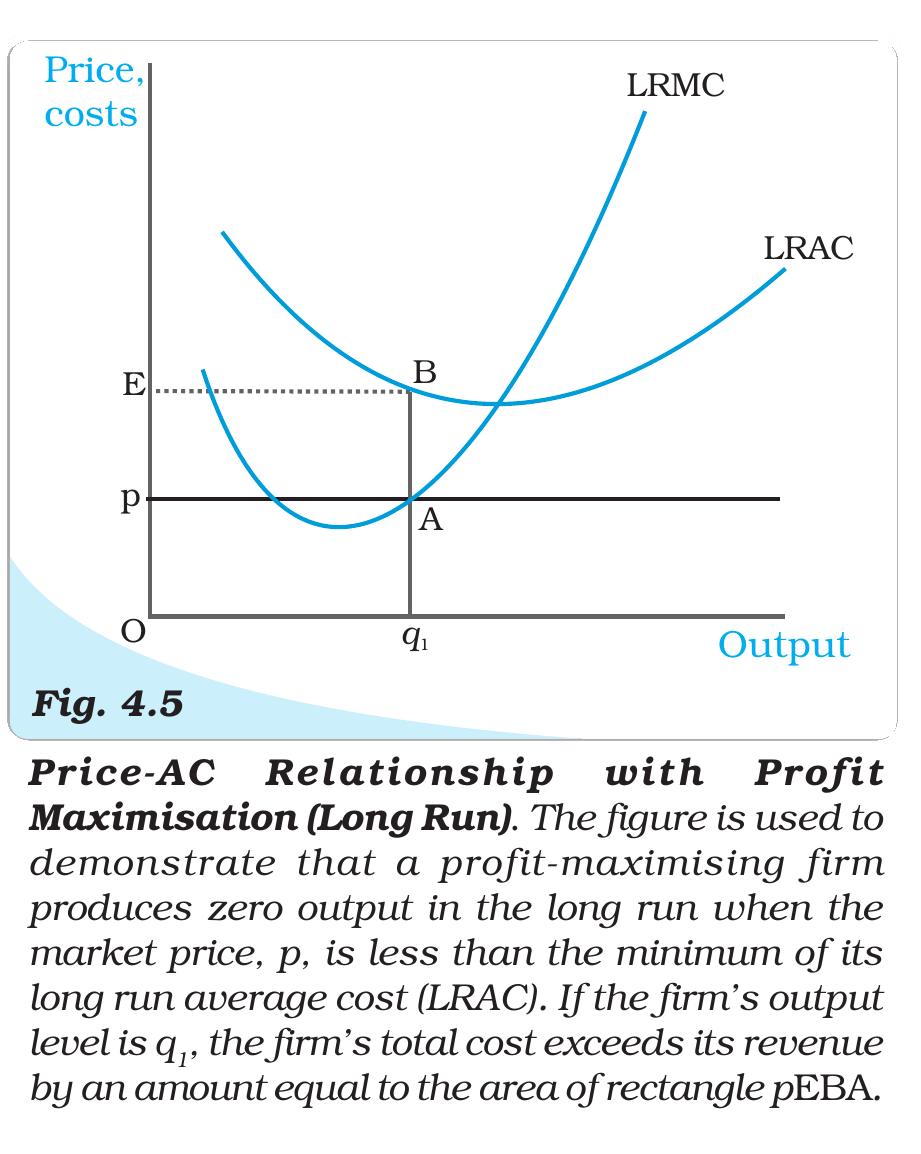
4.3.3 Condition 3 …Let us turn to Figure 4.5. Observe that at the output level q1, the market price p is lower than the (long run) AC. We claim that q1 cannot be a profit-maximising output level.… Notice that the firm’s total revenue, TR, at q1 is the area of the rectangle OpAq1 (the product of price and quantity) while the firm’s total cost, TC , is the area of the rectangle OEBq1 (the product of average cost and quantity). Since the area of rectangle OEBq1 is larger than the area of rectangle OpAq1, the firm incurs a loss at the output level q1.…”

NCERT extract

Advertisement

Practise more on Micro Economics: Theory of Firms under Perfect Competition

Chapter-wise mocks on the real NTA exam screen, with solutions and your rank. Your first mocks are free.

Start free mocks →

Advertisement

Next questions

  1. Which of the following is INCORRECTLY spelled.English · Spelling Check
  2. According to Selye's General Adaptation Syndrome, which of the following describes Rakesh's present condition?Psychology · Meeting Life Challenges
  3. An aircraft with a wingspan of 40 m flies with a speed of 1080 mathrmkm h^-1 in the eastward direction at a constant altitude in a region w…Physics · Electromagnetic Induction
  4. If […] =0 then the value of displaystylep/(p-a)+q/(q-b)+r/(r-c) isMaths. Section B1 · Determinants
  5. In the options given below which one is NOT a social issue?Sociology · Indian Society: Introducing Indian Society
  6. Which among the following codons codes for methionine and also acts as the initiator codon?Biology · Molecular Basis of Inheritance
  7. When was the first issue of Epigraphia Indica published?History · Ancient India: Kings, Farmers and Towns
  8. Which of the following are the major determinants of the "Earnings of an individual"?General Aptitude Test · General Knowledge
  9. Chemistry · Organic: Aldehydes, Ketones and Carboxylic Acids
  10. What does the letter 'M' stand for in the MRTP Act 1969?General Aptitude Test · General Knowledge