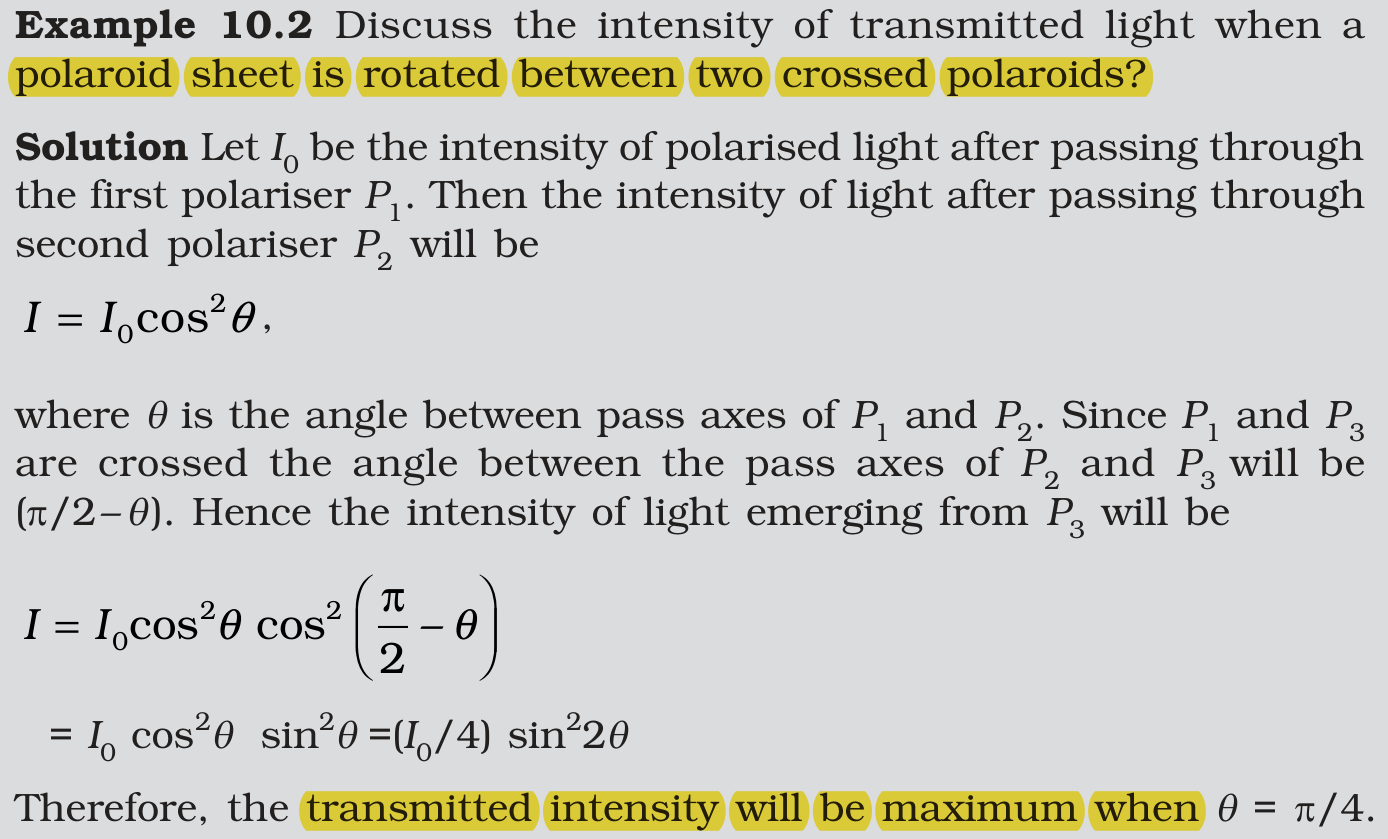
A polaroid sheet is rotated between two crossed polarizers. The intensity of transmitted light would be maximum, when the angle between the axes of the first polarizer and the polaroid sheet is
Answer & explanation
Correct answer: option 2
The correct answer is Option (2) → \( \pi/4 \)
Use Malus's law, \( I = I_1\cos^{2}\theta \), twice. Let \( I_0 \) be the intensity of the unpolarised light and \( \theta \) the angle between the axes of the first polarizer and the sheet. The first polarizer passes half of the intensity, \( I_0/2 \). The crossed polarizers have axes at \( 90^\circ \), so the axis of the sheet makes \( 90^\circ - \theta \) with the last polarizer.
\( \displaystyle I = \frac{I_0}{2}\cos^{2}\theta\,\cos^{2}(90^\circ - \theta) = \frac{I_0}{2}\cos^{2}\theta\,\sin^{2}\theta \)
\( \displaystyle I = \frac{I_0}{8}\sin^{2}2\theta \)
This is maximum when \( \sin 2\theta = 1 \), that is \( 2\theta = \pi/2 \).
\( \displaystyle \theta = \frac{\pi}{4} \)
Note: This question is from NCERT (2026-27). NTA sets numerical questions from NCERT too, so do not ignore NCERT while practising numericals.
NCERT (2026-27):
Polarisation – …