


CUET Preparation Today
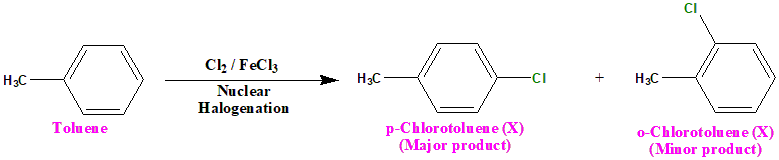
The reaction of toluene with \(Cl_2\) in the presence of \(FeCl_3\) gives \(X\) and the reaction in the presence of light gives \(Y\). Thus, \(X\) and \(Y\) are: |
\(X\) = Benzyl chloride, \(Y\) = m-Chlorotoluene \(X\) = Benzyl chloride, \(Y\) = o-Chlorotoluene \(X\) = m-Chlorotoluene, \(Y\) = p-Chlorotoluene \(X\) = o and p-Chlorotoluene, \(Y=\) trichloromethylbenzene |
\(X\) = o and p-Chlorotoluene, \(Y=\) trichloromethylbenzene |
The correct answer is option 4. \(X\) = o and p-Chlorotoluene, \(Y\) trichloromethylbenzene. Ferric chloride \((FeCl_3)\) acts as a Lewis acid catalyst in this reaction. It activates the \(Cl_2\) molecule, making it more electrophilic and susceptible to attack by the aromatic ring of toluene. When \(FeCl_3\) is present, the reaction takes place via electrophilic aromatic substitution (EAS). The electrophile \((Cl^+)\) preferentially attacks the ortho and para positions of the toluene ring due to the directing effect of the methyl group \((CH_3)\). This is because the methyl group is an electron-donating group (EDG), and it increases the electron density at the ortho and para positions, making them more susceptible to electrophilic attack. Therefore, the major products formed in this reaction are o-chlorotoluene and p-chlorotoluene (X).
On the other hand, when light is present, the reaction follows a different mechanism called radical chain chlorination. Chlorine molecules are broken down into chlorine radicals \((Cl^•)\) by the light energy. These radicals then react with the toluene molecule, leading to the formation of various products. The initial attack by the chlorine radical can occur at any position on the toluene ring, including the methyl group. As the reaction progresses, multiple chlorine atoms can substitute for hydrogen atoms on the same ring, eventually leading to the formation of trichloromethylbenzene (Y) as the major product.
|