


CUET Preparation Today
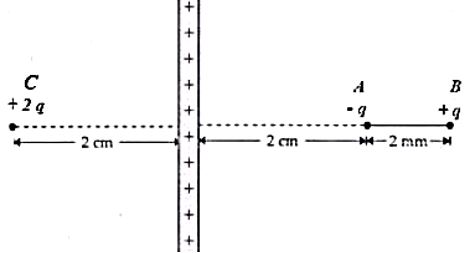
An electric dipole consists of charges $± 2 × 10^{-8} C$, separated by a distance of 2 mm. It is placed on the right side near a long line charge of density $4 × 10^{-4} C m^{-1}$. The negative charge of dipole is at a distance of 2 cm from the line charge as shown in figure. A positive charge (+2q) is placed on the left at 2 cm at point C. Given $q = 2 × 10^{-8} C$
(A) Force $|F_A|$ exerted on negative charge at point A due to line charge Choose the correct answer from the options given below: |
(D), (A), (B), (C) (A), (B), (D), (C) (B), (A), (D), (C) (C), (B), (D), (A) |
(D), (A), (B), (C) |
The correct answer is Option (1) → (D), (A), (B), (C) Given: linear charge density $ \lambda = 4\times 10^{-4}\ \text{C/m}$. Charges: $+q$ and $-q$ with $q = 2\times 10^{-8}\ \text{C}$, separated by $2\ \text{mm}=2\times10^{-3}\ \text{m}$. Point A (charge $-q$) is at distance $r_A = 2\ \text{cm}=0.020\ \text{m}$ to the right of the line. Point B (charge $+q$) is $2\ \text{mm}$ farther right, so $r_B = 0.020 + 0.002 = 0.022\ \text{m}$. Point C has charge $+2q$ at distance $r_C = 2\ \text{cm}=0.020\ \text{m}$ to the left of the line. Electric field magnitude due to an infinite line charge at distance $r$: $E(r) = \frac{\lambda}{2\pi\epsilon_0 r}$, where $\epsilon_0 = 8.854\times10^{-12}\ \text{F/m}$. Compute $2\pi\epsilon_0 = 2\pi(8.854\times10^{-12}) \approx 5.561\times10^{-11}\ \text{F/m}$. Force on a point charge $Q$ at distance $r$: $F = Q\,E(r) = \frac{\lambda Q}{2\pi\epsilon_0 r}$. Compute common numerator for $Q=q$: $\frac{\lambda q}{2\pi\epsilon_0} = \frac{(4\times10^{-4})(2\times10^{-8})}{5.561\times10^{-11}} \approx 0.1439\ \text{N·m}$. Magnitudes of forces: $|F_A| = \frac{0.1439}{r_A} = \frac{0.1439}{0.020} \approx 7.195\ \text{N}$ $|F_B| = \frac{0.1439}{r_B} = \frac{0.1439}{0.022} \approx 6.542\ \text{N}$ For $Q=+2q$ at C, numerator doubles: $\frac{\lambda (2q)}{2\pi\epsilon_0} \approx 0.2878\ \text{N·m}$, hence $|F_C| = \frac{0.2878}{r_C} = \frac{0.2878}{0.020} \approx 14.39\ \text{N}$ Directions: field of positively charged line points away from the line. At A and B (to the right of the line) the field is rightward. Force on $+q$ at B is rightward, magnitude $6.542\ \text{N}$. Force on $-q$ at A is leftward, magnitude $7.195\ \text{N}$. Net force on the dipole (rightwards positive): $F_{\text{net}} = +6.542\ \text{N} - 7.195\ \text{N} = -0.653\ \text{N}$. Magnitude of net force: $|F_{\text{net}}| \approx 0.653\ \text{N}$, direction toward the line (leftwards). Arrange magnitudes in decreasing order: $|F_C| \approx 14.39\ \text{N} \;>\; |F_A| \approx 7.195\ \text{N} \;>\; |F_B| \approx 6.542\ \text{N} \;>\; |F_{\text{net}}| \approx 0.653\ \text{N}$ Final Answer: $|F_C| > |F_A| > |F_B| > |F_{\text{net}}|$ |