Match List-I with List-II.
| List-I | List-II | ||
| (A) | Jai Jawan Jai Kisan | (I) | Ram Manohar Lohia |
| (B) | Garibi Hatao | (II) | Indira Gandhi |
| (C) | Non-Congressism | (III) | Lal Bahadur Shastri |
| (D) | Naxalite Movement | (IV) | Charu Majumdar |
Choose the correct answer from the options given below:
Answer & explanation
Correct answer: option 4
The correct answer is Option (4) → (A)-(III), (B)-(II), (C)-(I), (D)-(IV)
(A) Jai Jawan Jai Kisan — this matches (III) Lal Bahadur Shastri.
(B) Garibi Hatao — this matches (II) Indira Gandhi.
(C) Non-Congressism — this matches (I) Ram Manohar Lohia, the socialist leader who gave this strategy its name.
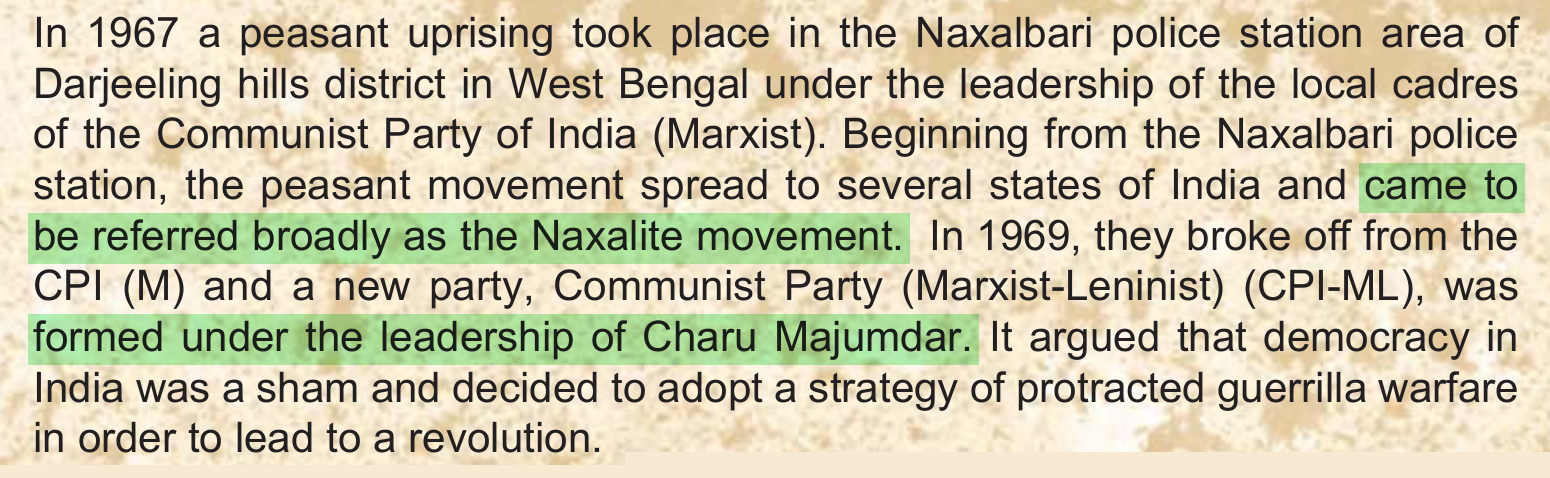
(D) Naxalite Movement — this matches (IV) Charu Majumdar. He led the Communist Party (Marxist-Leninist), formed by the Naxalites in 1969.
Note: The lines on the Naxalite movement that name Charu Majumdar, in the chapter ‘The Crisis of Democratic Order’, were there in the pre-rationalised NCERT; this portion has been deleted from subsequent editions of NCERT, including the NCERT book (2026-27), though the chapter is still there.
NCERT (2026-27): “From Nehru to Shastri … During Shastri’s brief Prime Ministership, the country faced two major challenges. While India was still recovering from the economic implications of the war with China, failed monsoons, drought and serious food crisis presented a grave challenge. As discussed in the previous chapter, the country also faced a war with Pakistan in 1965. Shastri’s famous slogan ‘Jai Jawan Jai Kisan’, symbolised the country’s resolve to face both these challenges.… Non-Congressism … The socialist leader Ram Manohar Lohia gave this strategy the name of ‘non-Congressism’. He also produced a theoretical argument in its defence: Congress rule was undemocratic and opposed to the interests of ordinary poor people; therefore, the coming together of the non-Congress parties was necessary for reclaiming democracy for the people. The contest … Yet the new Congress had something that its big opponents lacked – it had an issue, an agenda and a positive slogan. The Grand Alliance did not have a coherent political programme. Indira Gandhi said that the opposition alliance had only one common programme: Indira Hatao (Remove Indira). In contrast to this, she put forward a positive programme captured in the famous slogan: Garibi Hatao (Remove Poverty). She focused on the growth of the public sector, imposition of ceiling on rural land holdings and urban property, removal of disparities in income and opportunity, and abolition of princely privileges.…” NCERT (Pre-rationalised): Politics in India since Independence — Chapter 6: The Crisis of Democratic Order, box ‘The Naxalite Movement’
|