
A mill owner buys two types of machines A and B for his mill. Machine occupies 1000 sq. m of area and requires 12 men to operate; while machine B occupies 1200 sq. m of area and requires 8 men to operate it. The owner has 7600 sq. m of area available and 72 men to operate the machines. If machine A produces 50 units and machine B produces 40 units daily, how of each type should he buy to maximise the daily output? Use linear programming to find the solution.
Answer & explanation
Correct answer: option 1
The correct answer is Option (1) → 4 machines of type A and 3 machines of type B
Let x and y be the number of machines of type A and type B respectively which the mill owner should buy, then the daily production $P = 50x + 40y$ (units). Hence, the problem can be formulated as an L.P.P. as follows:
Maximize $P = 50x + 40y$ subject to the constraints
$1000x + 1200y ≤ 7600$ i.e. $5x + 6y ≤ 38$ (area constraint)
$12x+8y≤72$ i.e. $3x + 2y ≤ 18$ (labour constraint)
$x ≥0, y ≥ 0$ (number of machines cannot be negative).
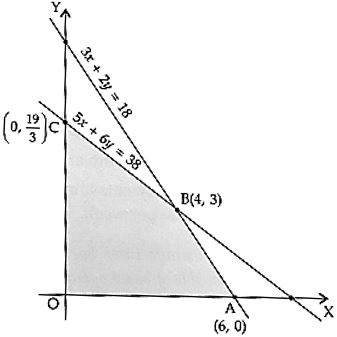
We draw the graphs of the straight lines $5x+6y= 38, 3x + 2y = 18$ and shade the region satisfied by the above inequalities. The shaded portion represents the feasible region, which is bounded.
The corner points of the feasible region are $O(0, 0), A(6, 0), B(4, 3)$ and $C(0, \frac{19}{3})$.
At $O(0, 0), P = 50 × 0 + 40 × 0 = 0,$
at $A(6, 0), P = 50 × 6 + 40 × 0 = 300,$
at $B(4, 3), P = 50 × 4 + 40 × 3 = 320$ and
at $C(0, \frac{19}{3}), P = 50.0 + 40 ×\frac{19}{3}=\frac{760}{3}=253\frac{1}{3}$
We find that maximum P(production) is 320 units at B(4, 3).
Hence, the mill owner should buy 4 machines of type A and 3 machines of type B.