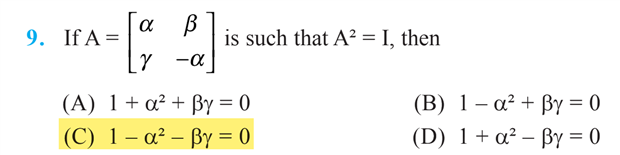
For \(I=\begin{bmatrix}1 & 0\\ 0 & 1\end{bmatrix}\), if \(A=\begin{bmatrix}a & b\\ c & -a\end{bmatrix}\) be such that \(A^2=I\), then:
Answer & explanation
Correct answer: option 2
The correct answer is Option (2) → \(1-a^2-bc=0\)
Multiplying A by itself (row by column):
\( \displaystyle A^2 = \begin{bmatrix}a & b\\ c & -a\end{bmatrix}\begin{bmatrix}a & b\\ c & -a\end{bmatrix} \)
\( \displaystyle = \begin{bmatrix}a^2 + bc & ab - ab\\ ac - ac & bc + a^2\end{bmatrix} \)
\( \displaystyle = \begin{bmatrix}a^2 + bc & 0\\ 0 & a^2 + bc\end{bmatrix} \)
A2 = I, so comparing the diagonal entries:
\(a^2 + bc = 1\)
\(1 - a^2 - bc = 0\)
NCERT (2026-27 edition):
Matrices