
Phenol on oxidation with chromic acid gives
Answer & explanation
Correct answer: option 4
The correct answer is Option (4) → Benzoquinone
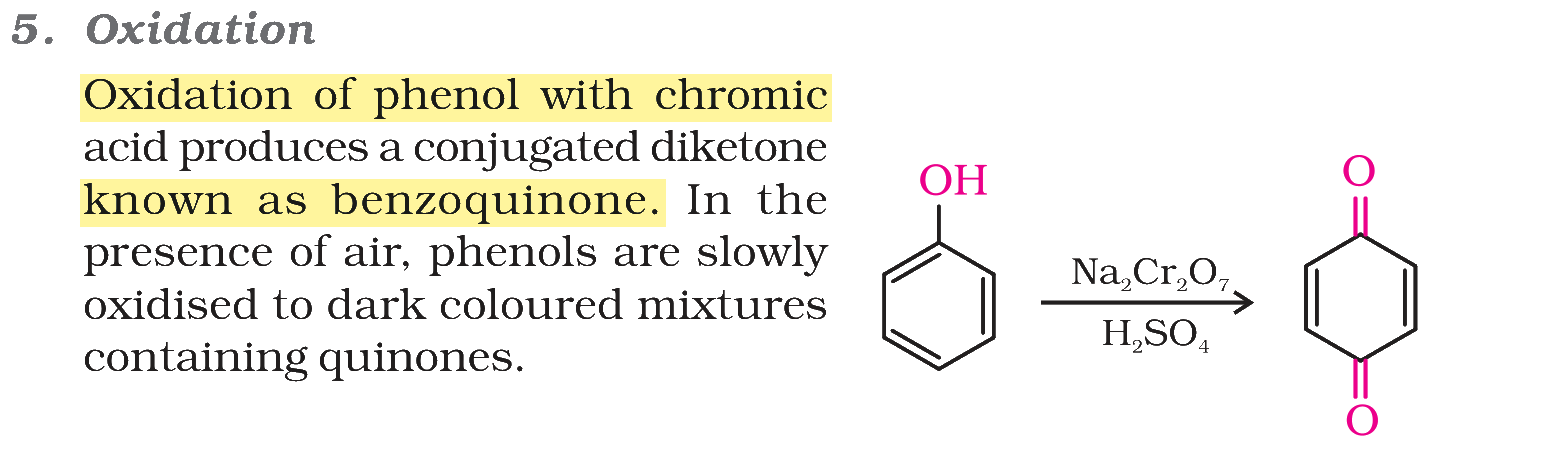
Phenol is easily oxidised because its ring is made electron-rich by the –OH group. With a strong oxidising agent such as chromic acid (sodium dichromate in sulphuric acid), the –OH carbon and the para carbon are both oxidised to C=O groups, and the product is a conjugated diketone, p-benzoquinone (cyclohexa-2,5-diene-1,4-dione):
\( \displaystyle \ce{C6H5OH} \xrightarrow[\ce{H2SO4}]{\ce{Na2Cr2O7}} \ce{O=C6H4=O}\ (p\text{-benzoquinone}) \)
Even air slowly oxidises phenols to dark coloured mixtures containing quinones, which is why old samples of phenol turn pink or brown.
Why the other options are incorrect
Option (1) Benzene — Incorrect. Phenol gives benzene on heating with zinc dust, which removes the oxygen; that is a reduction, not an oxidation.
\( \displaystyle \ce{C6H5OH + Zn} \xrightarrow{\Delta} \ce{C6H6 + ZnO} \)
Option (2) Benzaldehyde — Incorrect. A –CHO group on the ring needs a carbon side chain. Benzaldehyde is made by oxidising toluene, for example with chromyl chloride (Etard reaction); phenol has no side-chain carbon to oxidise.
Option (3) Quinol — Incorrect. Quinol (benzene-1,4-diol) is the reduced form of p-benzoquinone. Chromic acid is a strong oxidising agent and takes the oxidation of the ring as far as the quinone.
NCERT (2026-27 edition):
Oxidation
Note: The same/similar question has been asked in different years by NTA as per the details given below:
| 2026 | 2025 | 2024 | 2023 | 2022 |
|---|---|---|---|---|
| – | 29-05 S2 | – | – | 18-08 S1 |