CUETMOCK
  • Pricing
  • Mentors
Log inStart freeStart free mocks→

First test, then trust

Try a free CUET mock test.

Join 5,00,000+ students who rehearsed exam day on the exact NTA screen before sitting CUET. On the web and on Android.

Start free mocks →Get the Android app
CUETMOCK

India's #1 CUET Mock Test Platform. Original NCERT-based questions on the exact NTA exam screen — trusted by 5,00,000+ students since CUET 2022.

Get it onGoogle PlayScan to download the CUETMOCK app

Mock tests

  • CUET mock test series
  • Browse all papers
  • Commerce mocks
  • Humanities (Arts) mocks
  • Science mocks
  • Languages & GAT mocks
  • Free practice questions
  • Pricing

Resources

  • CUET exam guide
  • CUET syllabus
  • Universities accepting CUET
  • Expert blogs
  • News & notifications
  • Webinars & counselling
  • CUET score calculator
  • How we estimate your rank
  • FAQs

Company

  • About us
  • Our leadership & team
  • Our toppers
  • Mentors
  • For schools
  • Contact us
  • Terms
  • Privacy
  • Refund policy

Talk to us

+91 7696 6630 56info@cuetmock.comWhatsApp us

Our other platforms

  • JEE Mock — For IIT-JEE aspirants
  • NEET Mock — For NEET aspirants

Newsletter

Exam updates, study material and offers — no spam.

© 2026 NYC Ventures Pvt. Ltd.

701-702, Royal Business Park, Zirakpur, Punjab - 140603

  • Terms of use
  • Privacy policy
  • Refund policy
  • Contact us

iCUETMOCK is an independent preparation platform, not affiliated with the National Testing Agency (NTA). Always check exam details on the official NTA website.

  • Home
  • Mock tests
  • CUET guide
  • Pricing
  • Log in
Home/Practice questions/History
HistoryMedieval India: Bhakti Sufi Traditions

Arrange the following major religious leaders in a chronological orde…

Arrange the following major religious leaders in a chronological order.

A. Basavanna
B. Appar
C. Lal Ded
D. Mirabai
E. Kabir

Choose the correct answer from the options given below:

Answer & explanation+

Correct answer: option 1

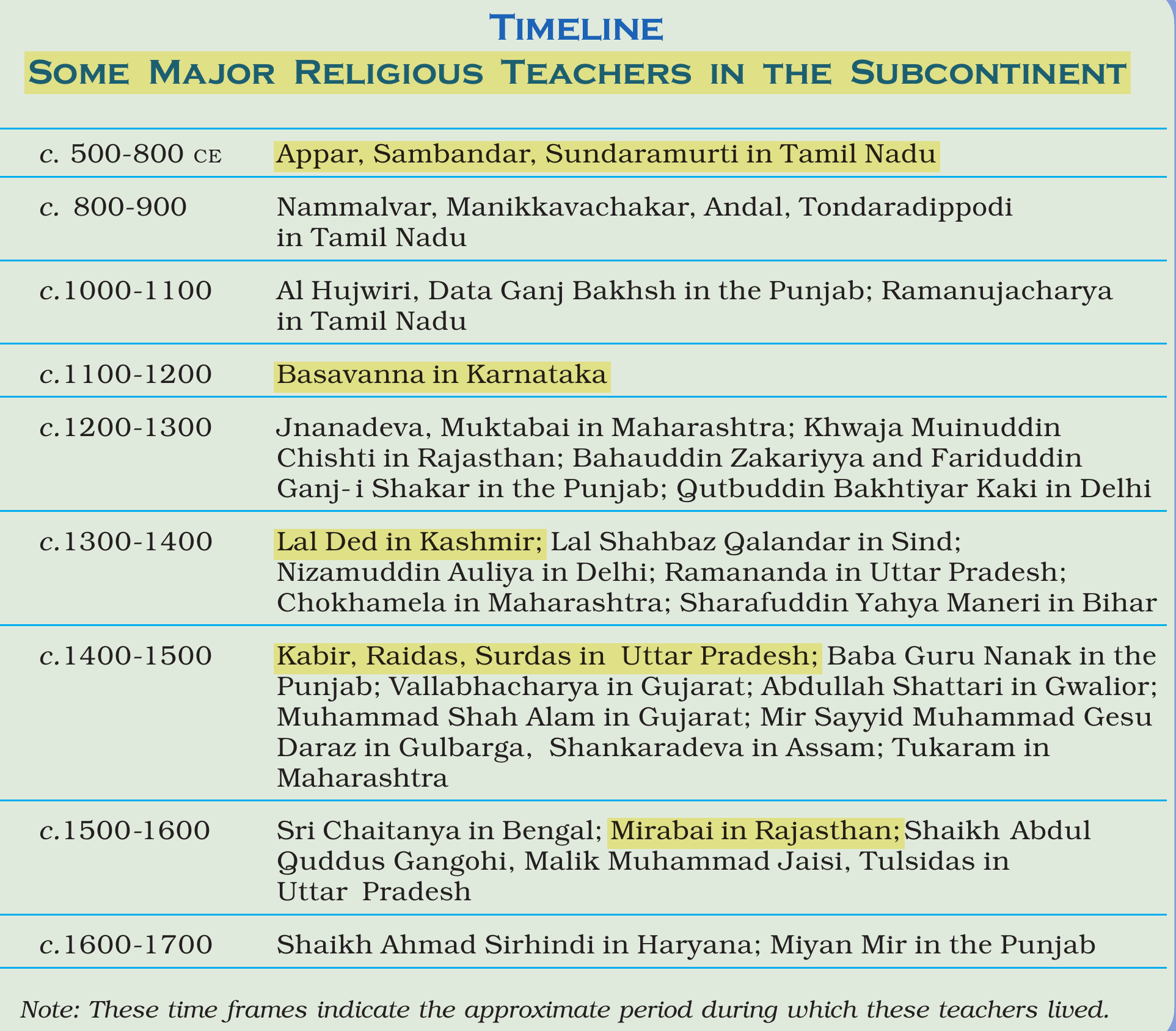
The correct answer is Option (1) → B, A, C, E, D

(B) Appar — c. 500-800 CE, in Tamil Nadu, the earliest of the five.

(A) Basavanna — c. 1100-1200, in Karnataka.

(C) Lal Ded — c. 1300-1400, in Kashmir.

(E) Kabir — c. 1400-1500, in Uttar Pradesh.

(D) Mirabai — c. 1500-1600, in Rajasthan.


NCERT: Themes in Indian History Part II — Chapter 6: Bhakti-Sufi Traditions (2026-27)

NCERT extract

Advertisement

Practise more on Medieval India: Bhakti Sufi Traditions

Chapter-wise mocks on the real NTA exam screen, with solutions and your rank. Your first mocks are free.

Start free mocks →

Advertisement

Next questions

  1. Four words have been given out of which three are alike in some manner, while one is different. Choose the odd one.General Aptitude Test · General Ability
  2. Select the letter will replace the question mark (?) in the following series. C, B, B, C, Z, E, W, H, S, ?, NGeneral Aptitude Test · General Ability
  3. 'मानव समाज में अरुण पड़ा, जल जंतु बीच हो वरुण पड़ा।इस तरह भभकता राणा था, मानो सर्पों में गरुड़ पड़ा।' इन पंक्तियों में कौन-सा रस निहित है?Hindi · व्याकरण - रस
  4. What is the mean of the first 10 prime numbers (correct to two decimal places)?General Aptitude Test · Numerical Ability
  5. Identify the Commissioner of Guntur who collected several sculpture panels from Amaravati and took them to Madras:History · Ancient India: Thinkers, Beliefs and Buildings
  6. Controlling is a systematic process involving sequential steps. Choose the correct sequence of Steps of Controlling Process. (A) Analysing…Business Studies · Controlling
  7. Fill in the blanks in the sentences in List-I with the correct forms of the verb “tidy” given in List-II.List-I (Sentences)List-II (Verb fo…English · Grammar: Tenses
  8. Method of Codification should be :Accountancy Part C · Overview of Computerised Accounting System
  9. Which among the following microbe help in the production of beer and bread ?Biology · Microbes in Human Welfare
  10. Which of the following term was not used for the First Gulf War?Political Science · Contemporary World Politics: US Hegemony in World Politics