
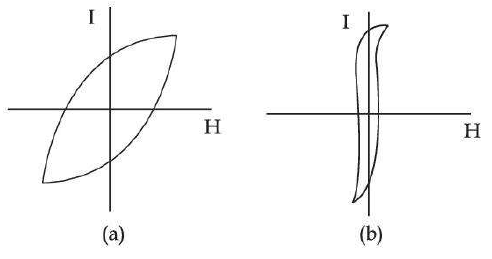
I → Intensity of magnetization
H → Magnetic intensity
(A) (a) is steel, (b) is soft iron
(B) retentivity of (b) > (a)
(C) (a) is used to make temporary magnets
(D) (b) can be easily demagnetised
Which of the given statements are correct?
Answer & explanation
Correct answer: option 2
The correct answer is Option 2: (A), (B) and (D)
The figure shows the I−H hysteresis loops of two ferromagnetic materials.
- A wide hysteresis loop indicates high coercivity and large hysteresis loss. Such materials are difficult to demagnetise and are used for permanent magnets. Therefore, graph (a) represents steel.
- A narrow hysteresis loop indicates low coercivity and small hysteresis loss. Such materials can be magnetised and demagnetised easily and are used for temporary magnets/electromagnets. Therefore, graph (b) represents soft iron.
(A) (a) is steel, (b) is soft iron: Correct. Steel is used for permanent magnets (wide loop), while soft iron is used for electromagnets (narrow loop).
(B) retentivity of (b) > (a): Correct. Retentivity is measured by the intercept on the III-axis when H=0. In the graph, loop (b) shows a larger I-axis intercept than loop (a), so statement (B) is correct (This is as per NTA answer key).
(C) (a) is used to make temporary magnets: Incorrect. Material (a) is steel, which is used for permanent magnets because of its high coercivity. Material (b) is used for temporary magnets (electromagnets).
(D) (b) can be easily demagnetised: Correct. Because loop (b) has a very low coercivity (narrow width), a small reverse magnetic field is sufficient to reduce its magnetization to zero.
Note : The given answer is as per NTA.