
If a young man rides his motor cycle at 25 km per hour, he has to spend ₹2 per kilometre on petrol; if he rides at a faster speed of 40 km per hour, the petrol cost increases to ₹5 per kilometre. He has ₹100 to spend on petrol and wishes to find the maximum distance he can travel within one hour. Express this as a linear programming problem and then solve it graphically.
Answer & explanation
Correct answer: option 2
The correct answer is Option (2) → 30
Let x km and y km be the distances covered by the young man at the speeds of 25 km/h and 40 km/h respectively, then time consumed in covering these distance are $\frac{x}{25}h$ and $\frac{y}{40}h$ respectively. Total distance travelled by the young man $D = x + y$ (kilometres).
Hence, the problem can be formulated as an L.P.P. as follows :
Maximize $D = x + y$ subject to the constraints
$2x+5y≤ 100$ (money constraint)
$\frac{x}{25}+\frac{y}{40}≤1$ i.e. $8x+5y≤ 200$ (time constraint)
$x ≥ 0, y ≥0$ (non-negativity constraints)
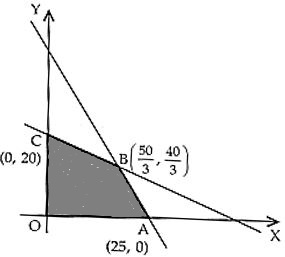
We draw the straight lines $2x + 5y = 100, 8x+5y= 200$ and shade the region satisfied by the above inequalities. The shaded portion shows the feasible region OABC which is bounded. The point of intersection of the lines is $B(\frac{50}{3},\frac{40}{3})$.
The corner points of the feasible region OABC are $Q(0, 0), A(25,0), B(\frac{50}{3},\frac{40}{3})$ and $C(0, 20)$.
The optimal solution occurs at one of the corner points.
At $Q(0, 0), D=0+0=0$
At $A(25,0), D=25+0=25$
At $B(\frac{50}{3},\frac{40}{3}),D=\frac{50}{3}+\frac{40}{3}=30$
At $C(0, 20),D=0+20=20$
We find that the value of D is maximum at $B(\frac{50}{3},\frac{40}{3})$.
Hence, the young man covers a total distance of 30 km, $\frac{50}{3}$ km at 25 km/h and $\frac{40}{3}$ km at 40 km/h.